


Smart Irrigation Controllers: Are They Worth the Investment?
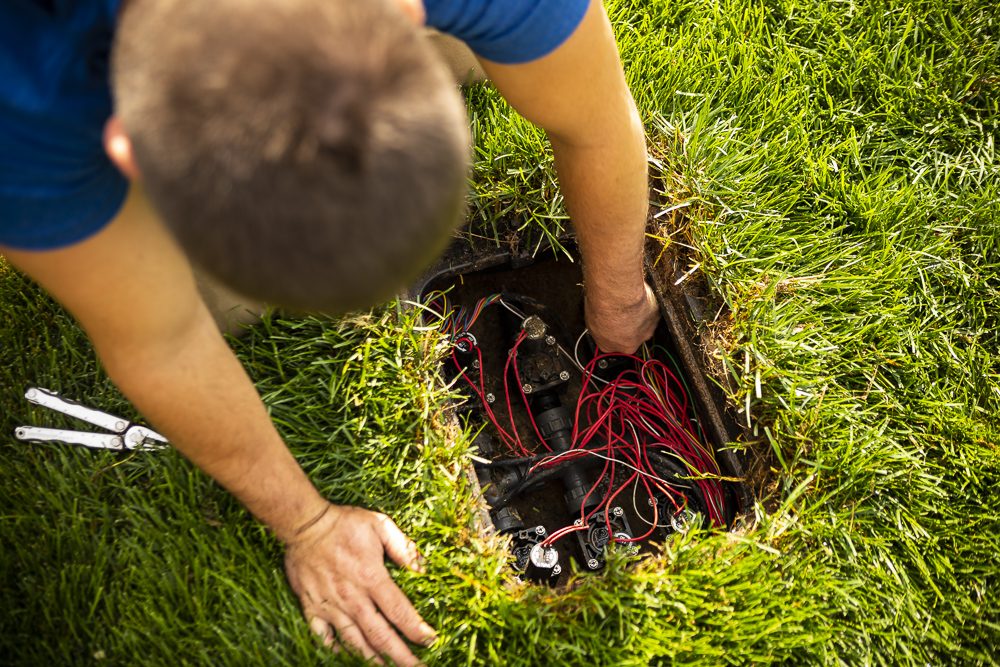
A smart irrigation controller adjusts watering to local weather instead of running a fixed schedule set in May. On most properties in Wisconsin and Minnesota, that means fewer cycles during a wet June, longer run times during a dry August, and no more watering through a rainstorm. It is the best single upgrade available to an existing system, with one condition: the system underneath it has to be in good shape.
What makes a controller smart
A conventional timer does exactly what it was programmed to do, forever. A smart controller takes in outside information and changes its own schedule. Two approaches dominate residential systems.
Weather-based controllers
These pull local weather data, either from an internet feed or an on-site sensor, and calculate how much water the landscape has lost to evapotranspiration since the last cycle. Run times rise and fall with temperature, humidity, wind, and solar conditions, and cycles are skipped after rain.
Soil moisture based controllers
These read actual moisture at the root zone through buried sensors and water only when the soil has dried to a set threshold. They are more precise, and they are the better answer on properties with mixed soils or problem zones, at the cost of sensors that have to be placed and maintained correctly.
Most models in either category also offer app control, zone-by-zone scheduling, seasonal adjustment, and alerts. Some support a flow sensor, which will tell you about a broken head or a stuck valve in the middle of the night rather than when the water bill arrives.
Where the savings actually come from
Smart controllers save water through a small number of specific behaviors, and it is worth knowing which ones apply to your property:
- Rain skip. The schedule is suspended during and after rainfall instead of running on top of it.
- Seasonal adjustment. Run times shrink in cool, cloudy weeks and grow during heat, automatically, instead of staying at whatever was set in spring.
- Cycle and soak. Long run times are split into shorter bursts with soak time between, so water infiltrates instead of running off clay soil or a slope.
- Day-level control. Watering restrictions and local ordinances can be built into the schedule and left alone.
The EPA WaterSense program tests and labels irrigation controllers for efficiency, so looking for the label is a reasonable shortcut when comparing models.
Why this fits the Upper Midwest
Our season is not consistent enough for a fixed schedule to be right for long. A program set during a cool, wet May delivers nowhere near what cool-season turf needs during a 90-degree stretch in late July, and the same program will happily run through four days of rain in June. A controller reading current conditions handles both ends of that swing without anyone touching it.
Fall is the other place it earns its keep. Run times should fall off sharply in September, but the system still needs to run if new seed is down, right up until the fall blowout. A smart controller manages the taper; you still need to schedule the winterization.
What a smart controller will not fix
This is the part that gets skipped in product reviews. A controller manages when and how long water runs. It has no idea where the water lands. If heads are tilted, nozzles are clogged, spray and rotor heads are mixed on one zone, or a zone was designed with gaps between heads, a smart controller will water those problems more precisely and you will still have brown spots.
Fix coverage first. A system check that straightens heads, clears nozzles, adjusts arcs, and verifies pressure is what makes the controller's math meaningful. Install the controller on a system that waters evenly and the savings show up; install it on a system with coverage problems and you will end up overriding it manually all summer.
Installation and setup
In most cases a smart controller mounts in place of the existing one and reuses the same field wiring, so installation is straightforward. The two practical constraints are power and signal: the unit needs reliable WiFi where it is mounted, which is a real question for a detached garage, and a controller mounted outdoors needs an outdoor-rated enclosure.
Setup is where results are won or lost. Each zone has to be entered accurately: plant type, head type, soil, slope, and sun exposure. A controller told that a shaded fescue zone is full-sun bluegrass will overwater it all season. Walk the zones with whoever installs it, and keep a rain sensor in the loop as a hardware backstop to the weather feed. Check with your water utility as well, since some offer rebates on WaterSense labeled controllers.
So is it worth it
For most properties with an in-ground system, yes. The payback is largest on bigger lots, on metered water where sewer charges track consumption, and in households where nobody was ever going to reprogram a timer twice a season. On a small, simple system owned by someone who adjusts their schedule monthly, the gain is smaller and mostly comes down to convenience and rain skip.
Bottom line
- Smart controllers save water through rain skip, seasonal adjustment, and cycle-and-soak, not magic.
- Weather-based models suit most homes; soil moisture sensors suit mixed soils and problem zones.
- They do not fix coverage. Straighten heads, clear nozzles, and correct zone design first.
- Accurate zone-by-zone setup determines the result more than the brand does.
- Look for the EPA WaterSense label and ask your water utility about rebates.
Frequently asked questions
Do smart sprinkler controllers really save water?
Yes, primarily by skipping cycles after rain and trimming run times in cooler weather instead of running a fixed spring schedule all season. The size of the savings depends on the schedule being replaced and on how evenly the system waters.
Will a smart controller work with my existing sprinkler system?
Usually. Most models mount in place of the old controller and reuse the existing field wiring. The requirements to check are WiFi coverage at the mounting location and an outdoor-rated enclosure if the controller is outside.
Do I still need a rain sensor with a smart controller?
It is worth keeping. A sensor at the property is a hardware backstop to a weather feed that may be reporting from several miles away.
Does a smart controller still need winterizing?
The controller itself stays put, but the system still needs a full fall blowout. The controller is set to off or rain mode for the season. Call 888-839-8484 to get on the blowout schedule.
EPA WaterSense, WaterSense labeled irrigation controllers.
Irrigation Association, Smart irrigation practices and equipment standards.


