


Salt, Calcium Chloride, Brine: Understanding Professional Snowmelt Products
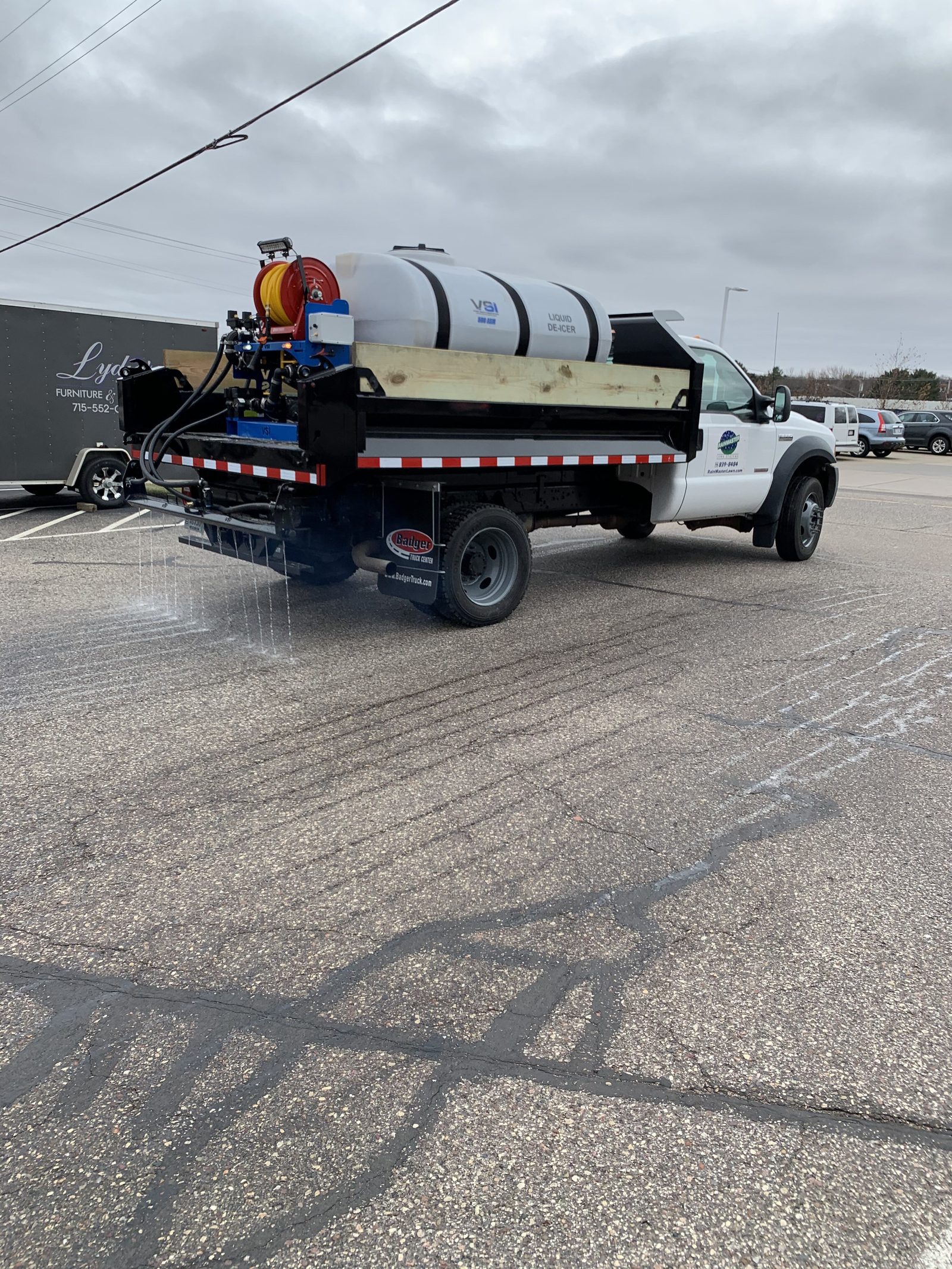
Not all ice melt is the same, and the differences matter for your concrete, your landscaping, your floors, and the lakes and streams downstream. RainMaster uses two products on commercial parking lots, sidewalks, and steps: treated rock salt and brine. Here is why.
The problem with plain rock salt
Traditional rock salt is sodium chloride, and it is the cheapest and most available ice melt, which is why it is still the industry default. The costs show up elsewhere.

Chloride does not break down. Once it is applied, it moves with meltwater into storm drains and from there into area lakes and streams, where it accumulates and harms aquatic life. Wisconsin and Minnesota both have documented chloride problems in surface water and groundwater, driven largely by winter salt use.
Closer to home, it burns surrounding landscaping where meltwater carries it into turf and beds, it pits and spalls concrete, and it gets tracked inside, where it damages floors, carpet, rugs, and door frames.
Rock salt also stops working when you most need it. Sodium chloride loses practical effectiveness around 15 to 20 degrees Fahrenheit. In a Minnesota or Wisconsin cold snap, plain salt applied to a lot largely sits there and gets scattered.
What treated rock salt is
Treated rock salt, also called enhanced rock salt, is rock salt with additives sprayed onto it to improve performance and reduce environmental impact. Magnesium chloride or calcium chloride is the usual addition.
Here is what that actually does, since it often gets described backward: salt works by lowering the freezing point of water, so ice melts at a temperature below 32 degrees. Adding magnesium or calcium chloride lowers that freezing point further, which extends the working range of the material into colder temperatures than plain rock salt can handle. The treated salt our crews use is rated to work down to about 20 degrees below zero.
Treated salt has two other practical advantages. It is less corrosive than plain rock salt, and it stays put instead of bouncing and scattering off the pavement. Material that stays where it was applied works where it was needed, which means we apply less of it overall. Using less is the environmental benefit that matters most.
Brine, and why pre-treating changes the job
Brine is a liquid mixture of water and salt, sprayed on parking lots, drive lanes, walkways, and steps, usually before a snow or ice event. It can also be applied after an event depending on how much snow fell.
The purpose of pre-treatment is to prevent the bond between ice and pavement from forming in the first place. When snow and ice cannot bond to a hard surface, plowing and shoveling clear it far more completely, which often eliminates the need to apply granular ice melt after the clearing is done.
Timing is the advantage. Brine can go down up to about three days ahead of a forecast event and it is ready the moment weather arrives. That turns snow service from reactive to proactive, which is the difference between a lot that is safe at 6 a.m. and a lot that gets treated at 9 a.m.
It also works immediately when it is cold. Granular salt has to dissolve into solution before it can do anything, and in very low temperatures that takes a long time while the material gets blown around. Brine is already in solution, so it starts working on contact.
Brine protects surfaces and landscaping
Applied as a liquid to hard surfaces, brine stays where it was sprayed. It does not migrate into lawns and planting beds the way granular salt scattered off a plow does, so landscape damage along lot edges and walkways drops substantially.
It also does not stick to boots. Granular salt gets tracked into buildings on shoes, which means entry mats, floors, rugs, and doorway hardware take the damage. Less tracking means less cleanup and less repair.
Brine uses less salt per square foot
Brine contains salt, at a much lower percentage than granular products. The practical result is that a property can be treated with a fraction of the chloride per square foot compared to broadcasting rock salt, which is the single most useful thing a commercial property can do to reduce its winter chloride load.
What this means for liability
For a commercial property manager the real concern is not chemistry, it is slip and fall exposure. Preventing a slick surface from forming is more defensible than responding to one after it forms, and it produces fewer incidents.
Pre-treating with brine ahead of forecast events, following with plowing and shoveling, and applying treated salt where conditions require it is the sequence that keeps surfaces clear with the least material and the least collateral damage. Ask any contractor you are considering which products they use and at what temperatures those products stop working. See our commercial snow removal services for how we structure that on a property.
Bottom line
- Plain rock salt is cheapest but loses effectiveness around 15 to 20 degrees, pits concrete, burns landscaping, and loads chloride into local water.
- Salt works by lowering the freezing point of water, and magnesium or calcium chloride additives lower it further.
- Treated rock salt is rated to work to about 20 below zero, is less corrosive, and scatters less, so less material is needed.
- Brine prevents ice from bonding to pavement, can be applied up to three days ahead, and works on contact in cold weather.
- Brine stays on hard surfaces, does not track into buildings, and uses a fraction of the salt per square foot.
Frequently asked questions
At what temperature does rock salt stop working?
Plain sodium chloride loses practical effectiveness around 15 to 20 degrees Fahrenheit. Treated salt with magnesium or calcium chloride additives extends that range considerably, and the product we use is rated to roughly 20 below zero.
Is brine better than salt for my landscaping?
Yes, in two ways. It uses far less chloride per square foot, and because it is sprayed onto hard surfaces as a liquid it stays there instead of scattering into lawn and planting beds.
How far in advance can brine be applied?
Up to about three days before a forecast event. It stays on the surface and starts working as soon as precipitation arrives, which is what keeps ice from bonding to the pavement.
Does brine eliminate the need for granular ice melt?
Often it reduces or eliminates the post-clearing application, because snow that never bonded to the surface plows off cleanly. Heavier or longer events can still call for treated salt.
Wisconsin Department of Natural Resources, Chloride and winter salt use guidance.
511 Wisconsin, Winter road conditions and travel information.


