


Rotary, Spray, & Drip: Understanding 3 Common Types of Lawn Sprinkler Heads
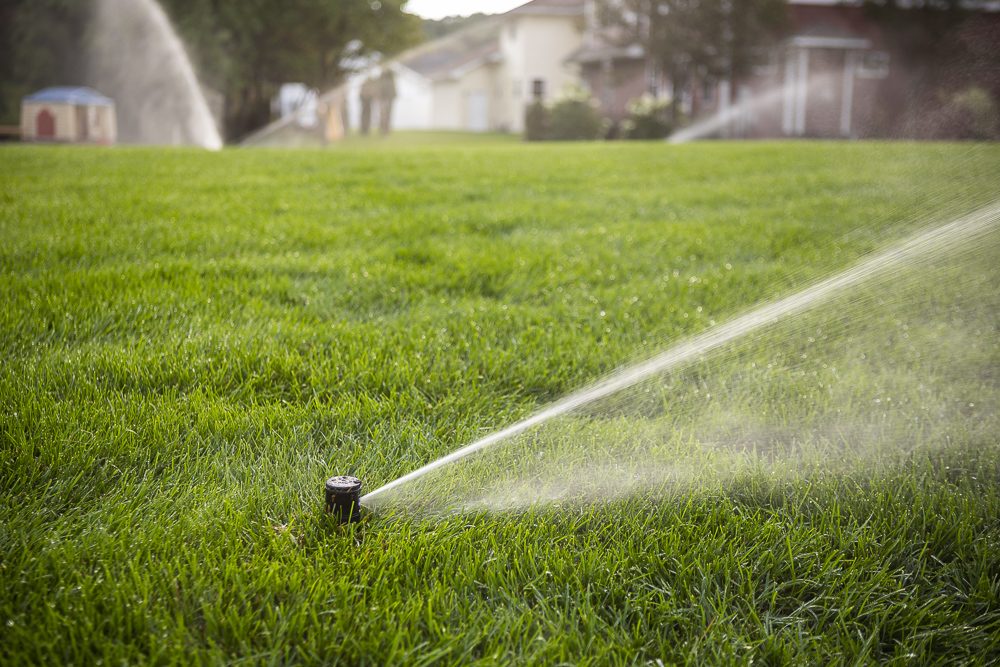
Most uneven watering traces back to the wrong head in the wrong place rather than a broken system. Rotary heads, spray heads, and drip line each do a specific job, and matching them to the shape and size of an area is what produces even coverage. Here is how each one works and where it belongs.
How pop-up sprinkler heads work
The common style on residential systems is the pop-up. When the zone is off, the head sits flush with the soil, out of sight and out of the way of mowers and foot traffic. When the zone turns on, water pressure pushes a riser up above the turf and the nozzle sprays. When the zone shuts off, a spring pulls the riser back down.

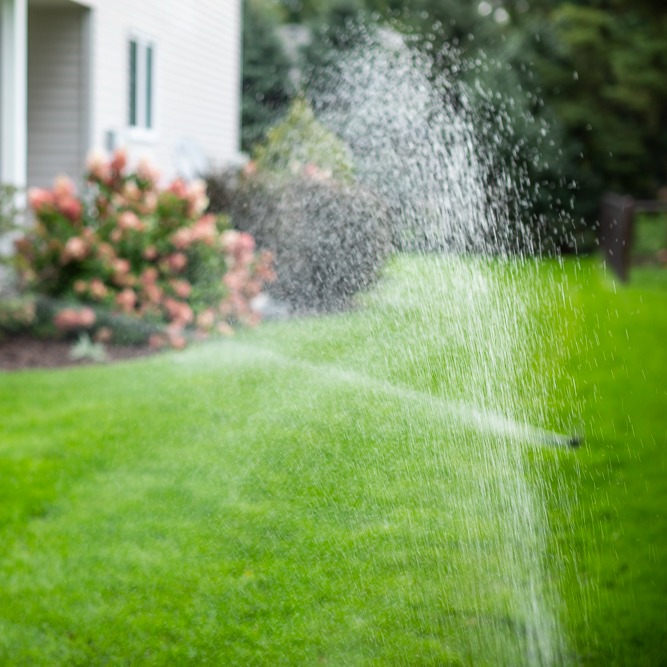
Standard pop-up height is four inches, which clears a typical lawn mowed at three to three and a half inches. Taller bodies are available up to twelve inches for planting beds, ornamental grasses, and anywhere the spray would otherwise be blocked. The nozzle screwed into the head determines the throw distance and the pattern, and the nozzle is usually the cheapest and most consequential part of the whole assembly.
The three main types
1. Spray heads
Spray heads cover smaller areas, typically with a throw of 5, 10, or 15 feet. They are fixed rather than rotating, spraying a set pattern determined by the nozzle: a quarter circle, half circle, full circle, or a strip pattern for a narrow bed.
Because they water their whole pattern at once, spray heads apply water fast. That is useful for small areas and it is also why they cannot share a zone with rotors, which apply water several times more slowly. Run them on one schedule and one group gets far too much or far too little.
If you have an older system, you may have original style spray nozzles that throw a heavy sheet of water and apply it faster than most soils can absorb it. Newer rotating nozzles, which look more like a set of fingers than an umbrella, break the stream into rotating streams and apply water at a much lower rate. The result is less runoff, more even coverage, and less wasted water. Upgrading nozzles is one of the cheapest improvements available on an existing system.
2. Rotary heads
Rotary heads throw the farthest and are built for large open areas. A single rotor can cover 30 feet or more, and the arc is adjustable from a narrow 30 degrees up to a full 360.
Here is the counterintuitive part. Homeowners with small yards often assume a couple of long throwing rotors will cover everything cheaply. Fewer heads, less money. In practice, a small or oddly shaped yard usually costs more per square foot to irrigate, because it needs more heads with shorter throws to fit the shape without throwing water where it does not belong.
Think about the strip of grass between the sidewalk and the street. A rotor there sprays into the road. That strip needs several short throw spray heads instead, and more heads means more trenching, more fittings, and more cost.
3. Drip irrigation
Drip is not a sprinkler head, but it is the third major delivery method and often the right answer. Instead of spraying, drip uses tubing with emitters that release water slowly, directly into the soil at the base of the plant.
Drip uses less water than spray irrigation for the same result, because nothing is lost to evaporation or wind drift and nothing lands on pavement. It is ideal for shrub beds, foundation plantings, and narrow strips where even a short throw spray head overshoots. It works in porch and patio planters too, which solves the daily watering can routine.
One limitation: drip is a poor match for a bed you till regularly, since tilling cuts the lines running just under the surface or the mulch.
Are stainless heads better than plastic?
Mostly no, and it is worth understanding why. On a pop-up head, the stainless refers to a steel sleeve on the riser. The internal components, the seal, the spring, the nozzle, and the body are generally the same as the plastic version. Stainless risers are useful in gritty or sandy conditions where abrasion is a problem, but on a typical residential lawn you are paying for a material difference that does not change performance. The nozzle selection and the spacing matter far more than the riser material.
The mistakes that cause brown spots and soggy areas
Most head problems on homeowner installed systems come down to a handful of errors.
- Wrong head for the area. A spray head where a rotor is needed leaves the far side of the area dry. A rotor in a small area throws water onto pavement and the house.
- Mixing head types on one zone. Rotors and spray heads apply water at very different rates. On the same zone, one group is always wrong.
- Too many heads for the available flow. Every zone has a flow budget in gallons per minute. Add a fifth head to a zone sized for four and pressure at each head drops, throw distances fall short, and in bad cases heads do not fully pop up.
- Wrong nozzle. The nozzle sets both the pattern and the volume. The wrong one leaves a gap in coverage that shows up as a brown crescent in August.
- Poor adjustment. Each head has to be set so the arc and throw land water where it is needed and nowhere else. Adjustment methods differ by brand, and some require a specific tool.
Landscape changes matter here too. Add a bed, move a walk, or plant a tree that grows up into a spray pattern, and heads need to be moved, added, or re-nozzled.
Keep the heads working with regular tune-ups
Heads take abuse, and a Wisconsin or Minnesota winter supplies most of it. Frost heave lifts and shifts them over four or five months of frozen ground, so they come up in spring spraying the driveway instead of the lawn. Soil settles and leaves a head low enough that turf blocks the pattern. Seals wear and leak. Mineral residue and grit flow down the line and clog nozzles. A snowplow or an edger takes a head off at the riser.
None of that announces itself. You find it when an area turns brown or the water bill jumps. Seasonal irrigation maintenance catches it, because someone is running every zone and watching each head perform.
Bottom line
- Spray heads cover 5 to 15 feet at a high application rate. Rotary heads cover 30 feet or more at a much lower rate.
- Never mix rotors and spray heads on the same zone. Their application rates are too different for one run time to serve both.
- Small and oddly shaped yards usually cost more to irrigate, because they need more short throw heads to fit the shape.
- Drip is the right choice for shrub beds, narrow strips, and planters, but not for beds you till.
- Stainless pop-up heads use the same internal components as plastic. Nozzle selection and head spacing matter far more than riser material.
Frequently asked questions
What is the difference between a spray head and a rotary head?
Throw distance and application rate. Spray heads cover 5 to 15 feet with a fixed pattern and apply water quickly. Rotary heads cover 30 feet or more with a rotating stream and apply water slowly. That difference is why they cannot share a zone.
Can I add another sprinkler head to an existing zone?
Only if the zone has flow capacity left. Each zone is designed around available gallons per minute, and adding heads beyond that drops pressure at every head, shortens throw distances, and can keep heads from popping up fully.
Are stainless steel sprinkler heads worth the extra cost?
On most residential lawns, no. The stainless is a sleeve on the riser, and the internal components are the same as the plastic version. It helps in abrasive sandy conditions, but nozzle choice and spacing have far more effect on coverage.
Is drip irrigation better than sprinklers?
For beds, foundation plantings, narrow strips, and containers, yes, because there is no evaporation or overspray. For lawn, no. Turf needs uniform coverage across a broad area, which is what spray and rotary heads are designed to deliver.
U.S. Environmental Protection Agency WaterSense, Sprinkler Spruce-Up.
Irrigation Association, Irrigation design and efficiency resources.


