


The Risks of Winterizing Your Own Irrigation System (& Why the Pros Handle It Best)
Clearing the water out of a sprinkler system before the first deep freeze is not optional in Wisconsin or Minnesota. It is also the job homeowners most often attempt with the wrong equipment, and the failure mode is expensive. Here is what actually goes wrong and why the tool matters more than the technique.
What is at stake
Water left anywhere in the system freezes, expands, and splits whatever is holding it. That means cracked pipe, cracked valves, a broken manifold, or a ruined backflow device, and repair costs that run from a few hundred dollars into the thousands.
If you make it through a winter with nothing visibly broken, that is not proof the blowout worked. Components that went through a freeze with water in them often fail prematurely later, which means the system lets you down in the middle of July rather than in April when you would notice it right away.
Why winterization matters so much here
In this climate the question is not whether we get hard freezes, it is whether they arrive before you have the mower put away. An early cold snap in October is normal, and once the ground and the pipe near the surface freeze, any remaining water does its damage.
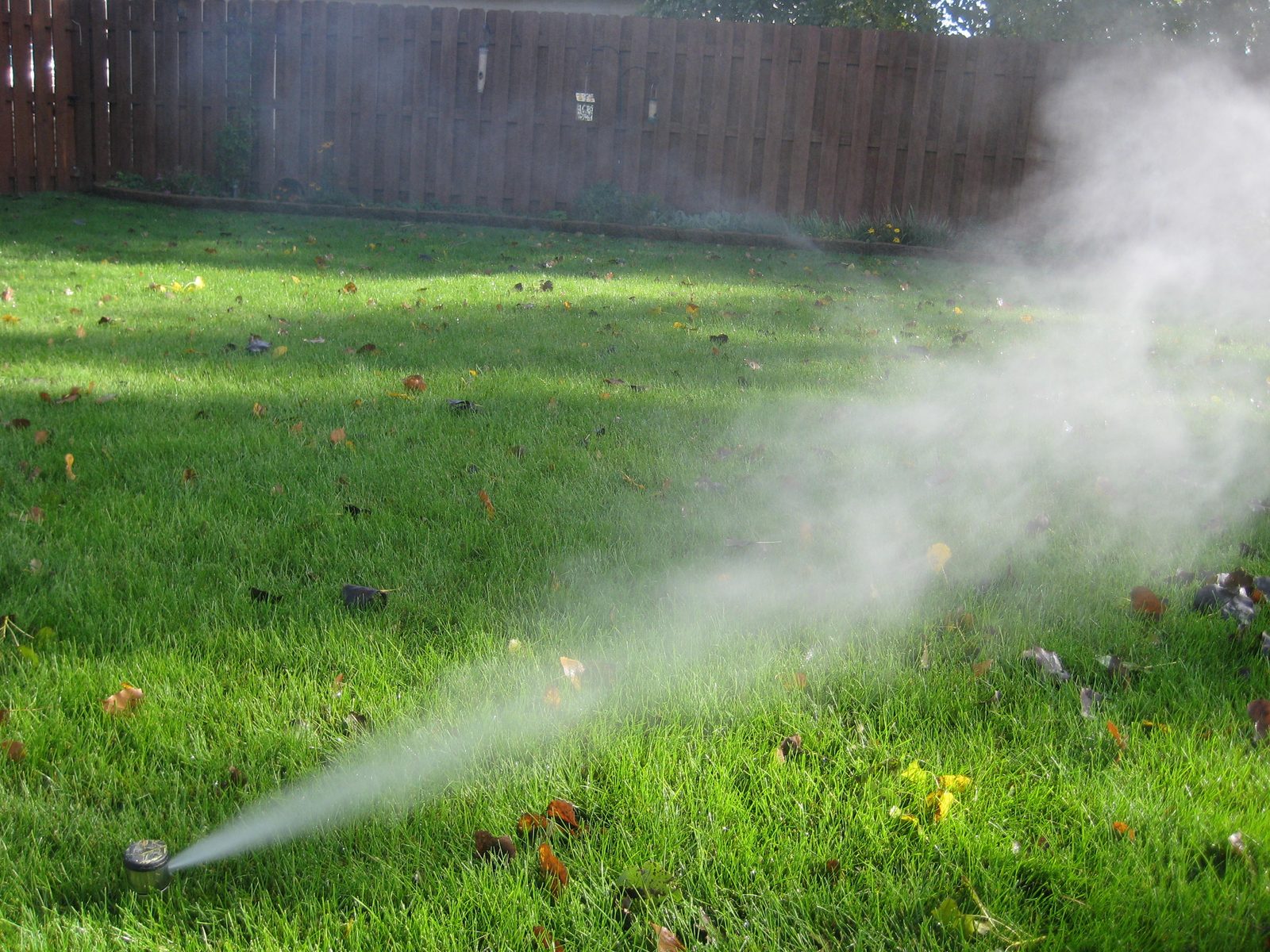
So the water has to come out of the pipes, valves, and heads before the first deep freeze. The method is forced air, pushed through the lines to drive the remaining water out through the heads.
Do not use your garage air compressor
The compressor in the corner of the garage looks like the right tool and is not, for a reason most people never hear.
A shop or garage compressor typically runs 100 to 160 psi. That is high pressure and low volume, which is what you want for an impact wrench and exactly wrong for clearing a sprinkler system. Blowing out irrigation lines requires a wall of air moving through a two inch pipe, which is a question of volume, measured in cubic feet per minute, not pressure.
How a professional compressor differs
Our compressor runs on a diesel engine and produces very large volumes of air at low pressure. We run between 60 and 80 psi.
That difference is the whole story. Most irrigation components are rated for roughly 100 psi. Push 120 psi or more through them and they come apart: heads blow off their risers, fittings separate, pipe splits. It is also genuinely dangerous, since a head leaving the ground under pressure is a projectile.
There is a second failure mode that surprises people. Leaving a compressor running too long on a zone, trying to get every last drop out, generates enough heat in the moving air to melt the plastic gears inside the sprinkler heads. The system looks fine until spring, when heads do not rotate.
High pressure with low volume also does the job badly. It pushes a narrow channel of air through the pipe and leaves water sitting in the low spots, which is precisely what you were trying to prevent.
Lake pumps need their own winterization
If the system draws from a lake or a river rather than municipal water, the pump is an additional piece of equipment that cracks if it freezes with water in it.
Winterizing it means adding RV antifreeze to protect the pump and lines, capping the pipe ends so animals do not move in over the winter, and disconnecting the wiring so the pump cannot be energized by accident while dry, which destroys the seal in seconds.
One more thing worth doing: pull the intake out of the water and store it for the winter. Spring flooding and ice movement carry intakes away every year.
Backflow preventers get damaged without proper winterization
The backflow preventer is the device that stops irrigation water from flowing back into the drinking water supply. Most residential systems tie into potable municipal lines, and irrigation water can pick up fertilizer, soil, bacteria, and pesticide. If that water flows backward into the supply line, it contaminates drinking water. The backflow device exists to make that impossible.
It also has the least tolerance for freezing of anything in the system. Water left in the body damages the internal components and can crack the body itself. A cracked backflow device means a malfunction the moment the system is pressurized in spring, and because the device sits on the potable water side, the repair may require a plumber rather than an irrigation technician.
Every backflow design winterizes differently, with its own sequence for closing the supply, opening test cocks, and draining the body. Getting the sequence wrong leaves water in a chamber you cannot see.
A professional winterization is more than the blowout
The blowout is the visible part. The rest of the list matters just as much:
- Shutting off the irrigation supply valve, which is frequently inside the house in a basement or utility room.
- Shutting off any other irrigation related valves indoors.
- Draining and winterizing the backflow device according to its specific design.
- Clearing every zone individually, which on a multi zone system takes a methodical pass rather than one long blast.
- Setting the controller to its off or rain mode for the winter so it does not try to run a cycle in January.
- Winterizing a lake pump and storing the intake if one is present.
A technician on the property is also looking at the system while they are there, which means small problems get flagged in the fall and fixed before spring startup rather than discovered during the first hot week of summer.
The savings do not survive the math
Doing it yourself saves just under $200. Our professional winterization is $189.
Against that, the repairs we perform because of improper winterization run from $300 to $1,500. A single cracked valve, a split manifold, or a damaged backflow device wipes out five to eight years of savings, and that is before counting the cost of the repair being discovered in May when you wanted the system running.
Every one of our irrigation maintenance programs includes winterization, which is the right place for it. It is a fixed annual task with a hard deadline and an expensive failure mode, which is the definition of something to put on a schedule rather than a weekend to-do list.
Bottom line
- Water left in pipes, valves, heads, or the backflow device freezes, expands, and cracks components. Repairs from improper winterization run $300 to $1,500.
- Garage compressors run 100 to 160 psi with low volume. Irrigation components are rated near 100 psi, so high pressure blows them apart while still leaving water in low spots.
- Professional blowouts use high volume at low pressure, 60 to 80 psi, and a compressor left running too long can melt the gears inside heads.
- Backflow devices each winterize differently and sit on the potable water side, so a cracked one may require a plumber in spring.
- Professional winterization is $189 against do it yourself savings of just under $200, which one cracked valve erases.
Frequently asked questions
Can I winterize my sprinkler system with my own air compressor?
It is the most common way homeowners damage a system. A garage compressor produces 100 to 160 psi at low volume, and most irrigation components are rated near 100 psi, so it can separate fittings and launch heads while still failing to clear water from low spots.
What psi should be used to blow out an irrigation system?
Low pressure and high volume. We run between 60 and 80 psi with a diesel compressor that moves large volumes of air. Volume in cubic feet per minute is what pushes the water out, not pressure.
When should an irrigation system be winterized in Wisconsin or Minnesota?
Before the first deep freeze, which can arrive in October here. Scheduling in early to mid fall avoids the risk of an early cold snap finding water still in the lines.
What happens if I skip winterization entirely?
Water freezes and expands in the pipes, valves, heads, and backflow device, cracking what it is in. Even when nothing visibly breaks, components that froze with water in them commonly fail early, often during peak watering season.
Irrigation Association, Irrigation system maintenance resources.
U.S. Environmental Protection Agency WaterSense, Landscaping Tips.


