


Pro Tips for Fertilizing & Watering After Your Aeration and Seeding

Aeration and overseeding either works or it does not, and the deciding factor is almost always what happens in the three weeks afterward. New seed has no root system and no reserves, so it lives or dies on how you water it. Here is the schedule, the handoff to deep watering, and the mistakes that cost people a whole seeding.
Watering right after aeration and seeding
New seed needs the opposite of what an established lawn needs. An established lawn wants deep, infrequent water. Fresh seed wants frequent and light, because the seed sitting in the top half inch of soil has to stay consistently moist to germinate at all, and that top half inch dries out in hours.
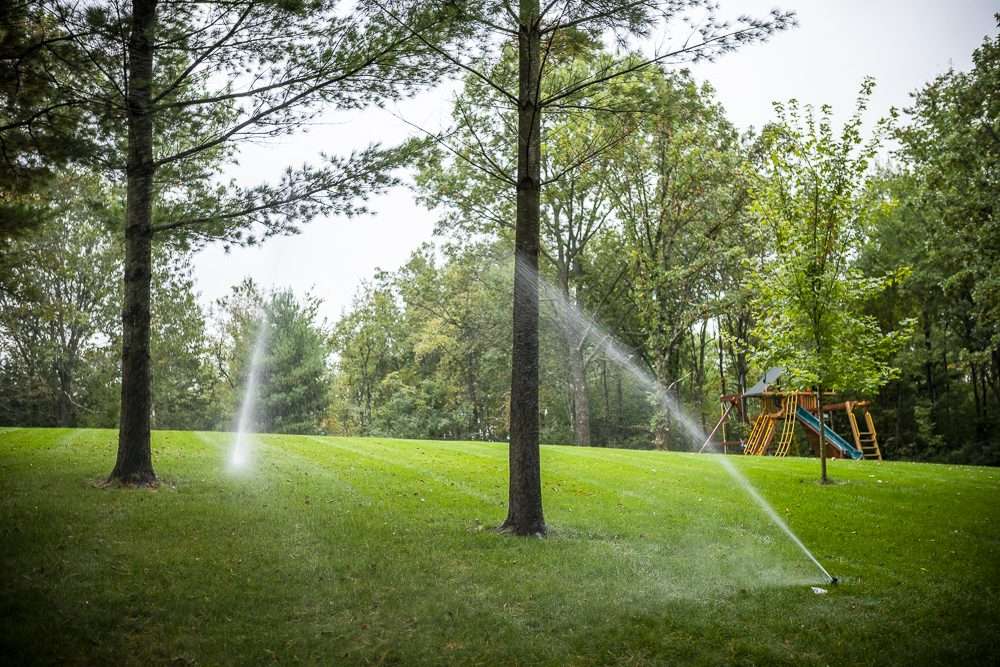

Plan on frequent light watering for the first month, roughly the twenty-one days it takes a typical cool-season mix to germinate, plus a buffer. In practice that usually means watering two or three times a day for fifteen to twenty minutes per zone. That month of babysitting is also why the seeding date matters: a mid August through mid September job in Eau Claire or the Twin Cities gets warm soil and cool nights, while anything seeded much later runs out of growing season before the first hard freeze.
Two things to get right:
- Consistently moist, never puddled. Standing water drowns seed and washes it into low spots and down the driveway. If you see runoff, shorten the cycles and add one.
- Do not stop. This is the one that kills seedings. If the surface dries out mid-germination, the seed either fails to come up or the seedlings that did emerge die with nothing to fall back on. There is no recovering from a missed weekend.
Note that a seed mix does not germinate all at once. Perennial ryegrass in a mix can be up in a week while the Kentucky bluegrass is still a couple of weeks out. Do not take the first flush of green as a signal to change the schedule.
Watering after germination
After four to six weeks, transition deliberately: longer cycles, fewer of them. The goal is now the opposite of the first month. You want the surface to dry between cycles so the roots are pushed to chase moisture downward, because deep roots are what carry the lawn through next summer.
Target about an inch of water a week, including rainfall, split across two or three sessions. That generally means running around forty-five minutes per zone so water soaks deep into the profile where roots are developing, rather than wetting the top inch and evaporating.
Make the transition in steps rather than all at once. Go from three short cycles a day to two, then to one, then to every other day with longer runs. Dropping straight from twenty minutes three times a day to forty-five minutes twice a week will stress young turf.
Fertilizing after aeration and seeding
New grass is hungry and has nothing stored. Follow the aeration and seeding with a regular fertilizing program rather than a single starter application and nothing after. A seedling stand that gets fed through its first fall and the following spring fills in dramatically faster than one left to figure it out.
Aeration timing is part of why this works. The holes left by core aeration give seed direct contact with soil instead of resting on thatch, and they give fertilizer a path into the root zone. Seeding into an un-aerated lawn is the most common reason a DIY overseeding produces almost no new grass.
Back off on weed killer
Do not use weed control products for at least a month after seeding. An easy way to track it: if you mow weekly, mow at least four times before you reach for anything.
Weeds will outgrow your new grass in that window and it will drive you crazy. Spray anyway and you will kill the seedlings along with the weeds, because new grass has none of the tolerance established turf has.
The one exception is professional product. If we are doing your lawn care, we have a pro-level material that controls weeds without harming new seedlings, and we can use it the day we seed.
Mow high, and keep raising the deck
Taller grass grows thicker and stays greener, and a new stand especially needs leaf surface to build a root system. As the season moves on, raise the mower rather than lowering it. Three inches in June, three and a half to four inches in July and August.
Wait until new grass reaches about three to four inches before the first mow, use a sharp blade, and make sure the ground is dry enough that the mower does not tear out seedlings or rut the aerated soil.
Why doing both services together matters here
Most lawn care and irrigation companies do one or the other. Aeration and overseeding is the project where that split costs you.
When RainMaster technicians aerate and overseed, you are not stuck renting an aerator and hoping you do not hit a sprinkler head, or guessing at a new controller schedule. We flag your sprinkler heads so the machine does not hit them. If we have access to the controller, we reset it for the watering schedule new seed needs, and then reset it again when the stand is established. No charge for either. Other companies charge $50 to $100 or more for the controller work, or simply hand it back to the homeowner. You can see the full scope of our irrigation services as well.
Beyond the convenience, coordination produces better results. The watering schedule and the seeding date are the same decision, and when one company owns both there is no gap between them.
Bottom line
- New seed needs frequent light watering, usually two or three cycles of fifteen to twenty minutes a day for the first month.
- Keep the seedbed consistently moist but never puddled. A dry spell mid-germination loses the seeding outright.
- After four to six weeks, transition in steps to about an inch a week over two or three longer cycles to drive roots deep.
- No weed control for at least a month, or four mowings, unless a professional product safe for new seedlings is used.
- Mow high and keep raising the deck: three inches in June, three and a half to four inches in July and August.
Frequently asked questions
How long do I water new grass seed after aeration and overseeding?
Frequent light watering for roughly the first month, two or three cycles of fifteen to twenty minutes a day, then a staged transition to about an inch a week in two or three longer sessions once the stand is established.
What happens if I miss a few days of watering?
Germinating seed and new seedlings have no reserves, so a dry stretch usually means losing them. If the seedbed has dried out, resume watering immediately and expect to reseed thin areas.
When can I apply weed control after seeding?
Wait about a month, or four mowings, with consumer products. Professional materials that are safe for new seedlings exist and can be applied the same day as seeding, which is one advantage of having the seeding done professionally.
When is the best time to aerate and overseed in Wisconsin and Minnesota?
Late August through mid September. Soil is still warm enough for fast germination, air temperatures have come down, fall rain is more reliable, and weed pressure is falling instead of rising.
University of Minnesota Extension, Seeding and sodding home lawns.
University of Wisconsin Extension, Lawn aeration and topdressing.


