


Mosquito Barrier Spray, Fogging & Misting: What’s the Difference?

Three different approaches get sold as mosquito control, and they are not interchangeable. The difference comes down to whether the insecticide is suspended in the air for minutes or left on the surfaces where mosquitoes actually rest.
Mosquito misting systems
A misting system is permanent equipment installed on the property. Spray nozzles are mounted at intervals around the perimeter of the house and connected by tubing to a reservoir of insecticide. The system is programmed to release a fine mist at set intervals, usually at dusk and dawn when mosquitoes are most active.
The mist hangs in the air briefly, and mosquitoes that fly through it are killed. Systems run on a timer, a remote, or a manual switch.
The limitations follow from the mechanism. The mist only affects mosquitoes that happen to be flying through that airspace during the few minutes it is suspended, so each cycle is effective for a short period rather than for days. Fine droplets also drift, so some of the material leaves the property in a breeze, and a timed system releases on schedule regardless of whether it is windy, raining, or whether people and pets are standing in the yard.
Mosquito fogging
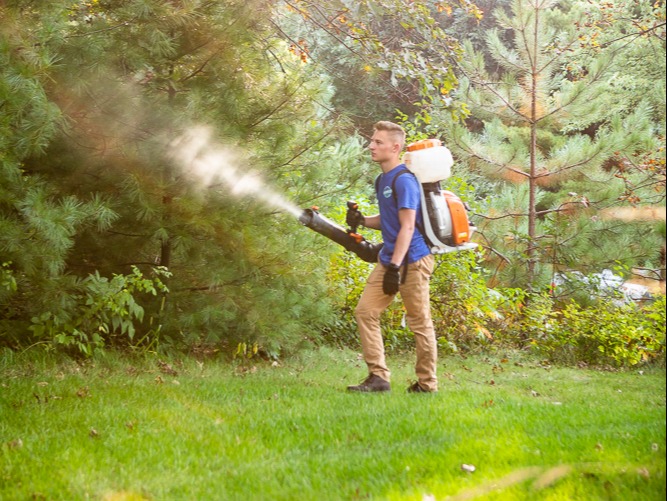
Fogging uses a backpack or handheld fogger to release a heated fog of insecticide across the yard. It is designed as a short-term knockdown, and most fogging treatments are effective for roughly 72 hours. The usual use case is an event: a graduation party, a wedding, a weekend at the cabin.
Fogging kills adult mosquitoes that are in the air and contact the fog as it moves through. It is not a season-long approach, and because the fog dissipates rather than settling on surfaces, it does little for mosquitoes sheltering under leaves or beneath a deck, and nothing for larvae in standing water.
Mosquito barrier spray
Barrier spray works on how mosquitoes actually spend their day. Mosquitoes are weak fliers, and they spend daylight hours resting on cool, shaded, humid surfaces, under leaves, in dense shrubs, below decks, to avoid drying out. They come out at dusk to feed.
A licensed technician applies the material with a backpack system that produces large droplets, coating those resting surfaces and the perimeter of the yard. Mosquitoes that land on treated surfaces are killed. Because the mosquito comes to the insecticide over the following weeks rather than the insecticide having to find the mosquito in one moment, coverage lasts.
We treat the places they lurk and breed:
- The undersides of plant leaves
- Shady areas
- Wet areas and low spots that hold water
- Under decks
- Under tree canopies
- Wood piles
RainMaster's barrier spray program reduces mosquitoes on the property through the season with regular visits every three weeks. It is designed to address developing larvae as well as adults, which matters because the mosquitoes biting you next week are in the water on your property right now.
Barrier spray versus misting, point by point
- Drift. Mist is carried on the wind and can move off your property. Barrier spray stays put once it dries on leaves and hard surfaces.
- Duration. A misting cycle is effective for a short period after each release. Barrier spray remains active for about three weeks and is reapplied on that cycle through the season.
- Judgment. An automatic misting system does not know whether people or pets are in the yard. A technician confirms the area is clear during the application and asks that people and pets stay off treated areas for about 30 minutes while it dries. After that the yard is used normally.
- Weather. A timer releases in wind and rain, which wastes material. A technician reschedules a treatment when conditions would waste it.
- Target. Misting kills adults flying through the airspace. Barrier spray treats the specific areas where mosquitoes rest and where they lay eggs, including damp low spots, so it addresses larvae too.
- Equipment. A misting system is installed infrastructure with a reservoir to refill and nozzles and tubing to maintain. Barrier spray requires nothing permanent on the property.
Barrier spray versus fogging, point by point
- Longevity. Fogging is a 72 hour fix. Barrier spray holds for about three weeks per visit and runs the whole season.
- Residual. Fog dissipates. Barrier material remains on surfaces, continuing to work as mosquitoes land.
- Life stages. Fogging does not reach larvae or eggs. Barrier applications include the damp areas where eggs are laid.
- Harborage. Fog does not reliably penetrate the underside of foliage or the space beneath a deck. Barrier spray is applied directly to those areas.
- Best use. Fogging makes sense the afternoon before a specific event. Barrier spray makes sense for a season of normal backyard use.
What no treatment can overcome
Standing water. Every mosquito needs water to complete its life cycle, and most of the mosquitoes biting you were produced within a few hundred feet of where you are standing. A clogged gutter, a tarp with a sag in it, a saucer under a planter, a tipped wheelbarrow, or a low spot that holds water for a week will keep producing generations regardless of what is on your shrubs.
So the honest version is that the treatment is half the program and the property is the other half. Dump anything that holds water every week, clear leaf litter, keep gutters open, and keep the lawn mowed. Then a barrier application on a three week cycle holds the line through the season.
One more regional note: the same barrier treatment reduces ticks on the property, which matters in the Chippewa Valley and the Twin Cities metro where blacklegged ticks are present along wooded edges. It lowers exposure in your own yard, but it does not replace the tick prevention your veterinarian recommends for pets. See mosquito and tick control for how a season is scheduled.
Bottom line
- Misting systems kill mosquitoes flying through the mist for a short window per cycle, and the droplets can drift off the property.
- Fogging is a 72 hour knockdown suited to a specific event, not a season.
- Barrier spray coats the shaded surfaces where mosquitoes rest, stays put once dry, and lasts about three weeks per visit.
- Barrier applications include the damp low spots where eggs are laid, so they address larvae as well as adults.
- No treatment overcomes standing water, so dump anything holding water weekly.
Frequently asked questions
How long does mosquito barrier spray last?
About three weeks, which is why applications are scheduled on a three week cycle through the season. The material stays on treated foliage and harborage surfaces and kills mosquitoes that land on them.
Is a mosquito misting system better than professional spraying?
Misting addresses only mosquitoes flying through the airspace during each short release, releases on a timer regardless of weather or who is outside, and requires permanent equipment and refills. A barrier application treats the surfaces mosquitoes rest on and holds for weeks per visit.
Does fogging get rid of mosquitoes for the summer?
No. Fogging is a short-term knockdown effective for roughly 72 hours, which makes it useful before an outdoor event. It leaves no residual on surfaces and does not affect larvae, so mosquito numbers rebound within days.
How soon can we use the yard after a barrier treatment?
Once treated areas are dry, generally about 30 minutes. Cool, humid, or heavily shaded conditions can take longer, so give it extra time if foliage still feels damp.


