


Liquid Brine vs. Rock Salt: Which is Best For Commercial Properties in WI and MN?

Liquid brine is a salt and water solution sprayed on pavement, usually before a storm, so snow and ice cannot bond to the surface. Rock salt is dry granular salt applied after accumulation, which has to dissolve before it does anything. For most commercial properties in Wisconsin and Minnesota, brine does more of the work with less material, and rock salt stays in the mix for the heavier events.
Snow and ice management on a commercial site is a liability problem before it is a landscaping problem. The question of brine versus rock salt is really a question of when the material goes down, how much of it stays where you put it, and what it does to your pavement and your lobby floors.
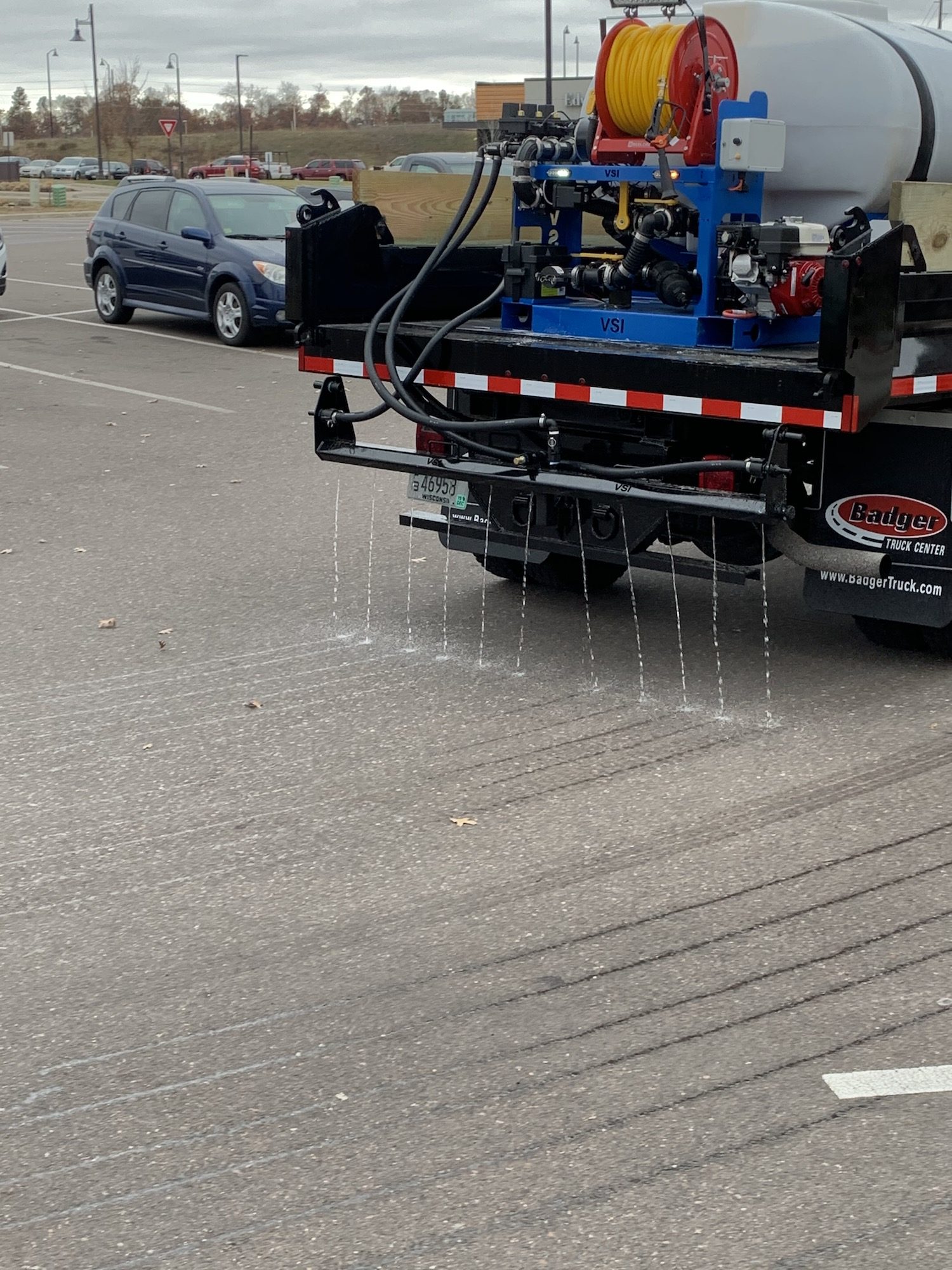

What brine actually is
Brine is a mixture of roughly 23.3 percent salt in water. That concentration is not arbitrary. It is the point where a salt solution resists freezing to the lowest temperature, so it is the standard mix for anti-icing work. Because the salt is already dissolved, brine goes to work on contact. Rock salt has to find enough moisture on the pavement to dissolve first, which is why a dry, cold lot treated with granular salt can sit there doing very little.
Brine also covers a larger area with far less salt per square foot. Same treated surface, meaningfully less chloride applied.
Anti-icing versus deicing
Anti-icing means treating pavement before a storm so ice never forms a bond with the surface. Deicing means breaking a bond that has already formed. The first takes a fraction of the material and labor of the second.
On a light snow event, brine applied before the snow and again on top of it is often the entire treatment a property needs. No plowing, no granular salt, no refreeze cleanup the next morning.
Brine and rock salt, head to head
- It stays where you put it. Granular salt bounces and scatters off pavement into turf and planting beds, where it burns grass and shrubs. You pay for salt that lands somewhere it does damage. Brine stays on the surface it was sprayed on.
- Less tracking indoors. Rock salt sticks to boots and gets walked across lobbies and hallways. That is rug cleaning, floor refinishing, and white residue on everything. Brine does not come inside with your tenants and customers.
- Easier on surfaces. Concrete, pavers, handrails, and stair nosings all take less abuse from a measured liquid application than from repeated heavy granular salting.
- Faster to apply. A spray application covers a large parking lot quickly, which matters when you are working a pre-storm window.
- Immediate effect. No waiting for granules to dissolve.
Where rock salt still earns its place
Brine is not a replacement for everything, and any contractor who tells you it is should be questioned. Granular material still makes sense after real accumulation, on hard-packed areas, and on refreeze. Brine also has a practical temperature floor; as pavement temperatures drop well below freezing, a plain salt solution loses effectiveness and the job shifts to blended liquids or mechanical clearing plus granular treatment.
There is also a timing rule that gets ignored. Pre-treating ahead of rain, or ahead of a storm that will start as rain, wastes the application because it washes off before it can do anything. A good crew watches the forecast for precipitation type, not just for snow totals.
Chlorides, lakes, and spring damage
Chloride does not break down. Once it is applied, it moves with meltwater into storm drains, streams, lakes, and groundwater, and it stays there. Both Minnesota and Wisconsin have monitored chloride levels in urban waters for years, and the Twin Cities metro and the Chippewa Valley both have waters affected by winter salt use. The only real lever available to a property owner is applying less chloride, which is exactly what brine does on a per square foot basis.
The visible version of the same problem shows up on your own site in April, as dead brown strips of turf and burned shrub edges along drive lanes and walks. Reducing material and keeping it on pavement reduces that cleanup.
What this means for liability
Slip and fall claims are the reason most commercial snow contracts exist. Pre-treatment helps on both sides of that: fewer slick surfaces to begin with, and a documented record of what was applied and when. A serious program includes a site map with entrances, accessible parking stalls, fire lanes, and known problem areas like downspout discharge points and low spots that refreeze overnight, plus a defined priority sequence and refreeze patrols.
What a brine program looks like on your property
- A pre-season site walk to map drainage, shaded areas, slopes, and the surfaces that cannot take heavy salt.
- A written service plan with trigger depths, priority order, and communication expectations.
- Pre-storm application in the window where pavement is dry and the forecast is for snow rather than rain.
- Storm monitoring, plowing when accumulation calls for it, and targeted granular treatment where brine alone will not hold.
- Post-storm follow-up on refreeze, especially at entrances and in shaded corners of the lot.
If you manage property in the Twin Cities or around Eau Claire and your current program is built entirely around granular salt after the fact, there is room to cut material, cut interior cleanup, and reduce your exposure at the same time. Our commercial snow and ice management crews can walk the site and build the plan around it.
Bottom line
- Brine is a 23.3 percent salt solution that works on contact; rock salt has to dissolve before it does anything.
- Applied before a storm, brine keeps ice from bonding to pavement, which takes far less material than breaking that bond later.
- Brine stays on the pavement instead of scattering into turf and tracking into buildings on boots.
- Rock salt still has a role after accumulation, on hard pack, and at lower pavement temperatures.
- Lower chloride use protects local lakes and streams and cuts the spring turf and shrub damage along your drive lanes.
Frequently asked questions
Is liquid brine better than rock salt?
For preventing ice from forming, yes. Brine applied before a storm uses less salt, works immediately, and stays on the pavement. Rock salt is still useful after accumulation and at lower pavement temperatures, so most commercial programs use both.
Does brine work in very cold weather?
A plain salt brine loses effectiveness as pavement temperature drops well below freezing. In that range the work shifts to blended liquids or to mechanical clearing combined with granular treatment.
Will brine damage my parking lot or landscaping?
Brine is gentler on concrete, pavers, and handrails than repeated heavy granular salting, and because it is sprayed rather than scattered, far less of it ends up in the turf and beds along the pavement.
When should a commercial lot be pre-treated?
Before the storm arrives, while the pavement is still dry. Pre-treating ahead of rain, or ahead of a storm that begins as rain, washes the application away before it can work.
Wisconsin Department of Natural Resources, Chloride and winter salt use information.
Wisconsin Department of Transportation, Winter road maintenance and driving safety.


