


Irrigation Control: How Overwatering Can Damage Your Lawn & Cost You Money
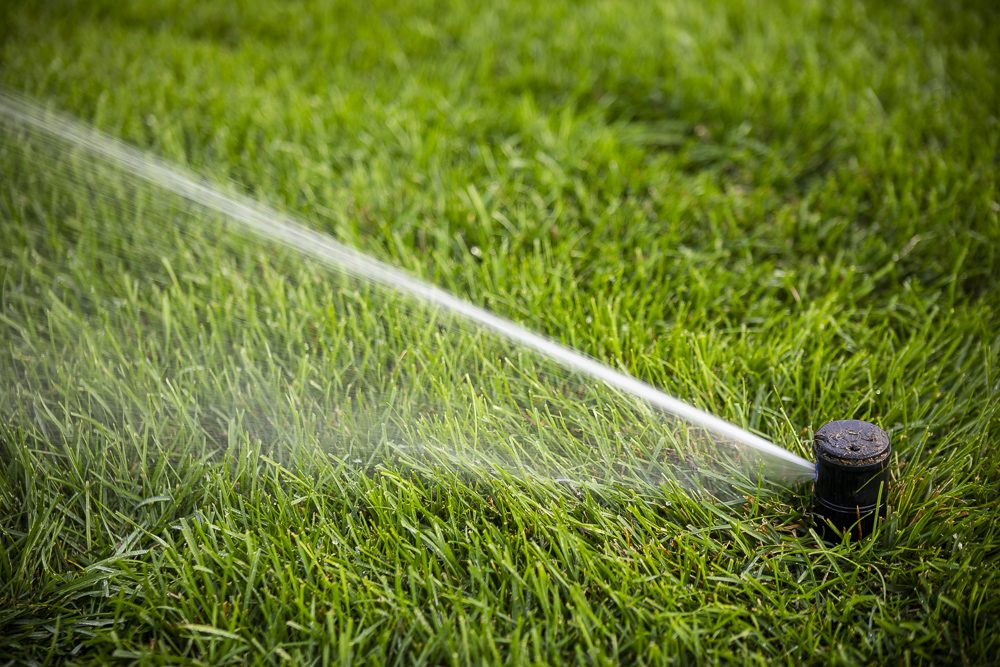
Too much water is a more common problem than too little in managed lawns, and it is harder to spot because the instinct when grass looks bad is to water it more. Saturated soil pushes oxygen out of the root zone, and roots that cannot breathe cannot support healthy grass.
What overwatering actually does
Roots need air as much as they need water. Water fills the pore spaces in soil, and when those spaces stay full, oxygen cannot reach the roots. The grass responds by thinning, yellowing, and becoming an easy target for disease and insect pressure. Keep it up long enough and sections die.
The frustrating part is that an overwatered lawn and an underwatered lawn can look similar from a distance. Both go off color and thin out. That is why the diagnosis has to come from the soil and the system, not from the color of the grass.
The signs of an overwatered lawn
- Pale or yellow color. Healthy cool-season turf is a deep green. Washed out, yellowish color across an area that gets plenty of water usually means too much, not too little.
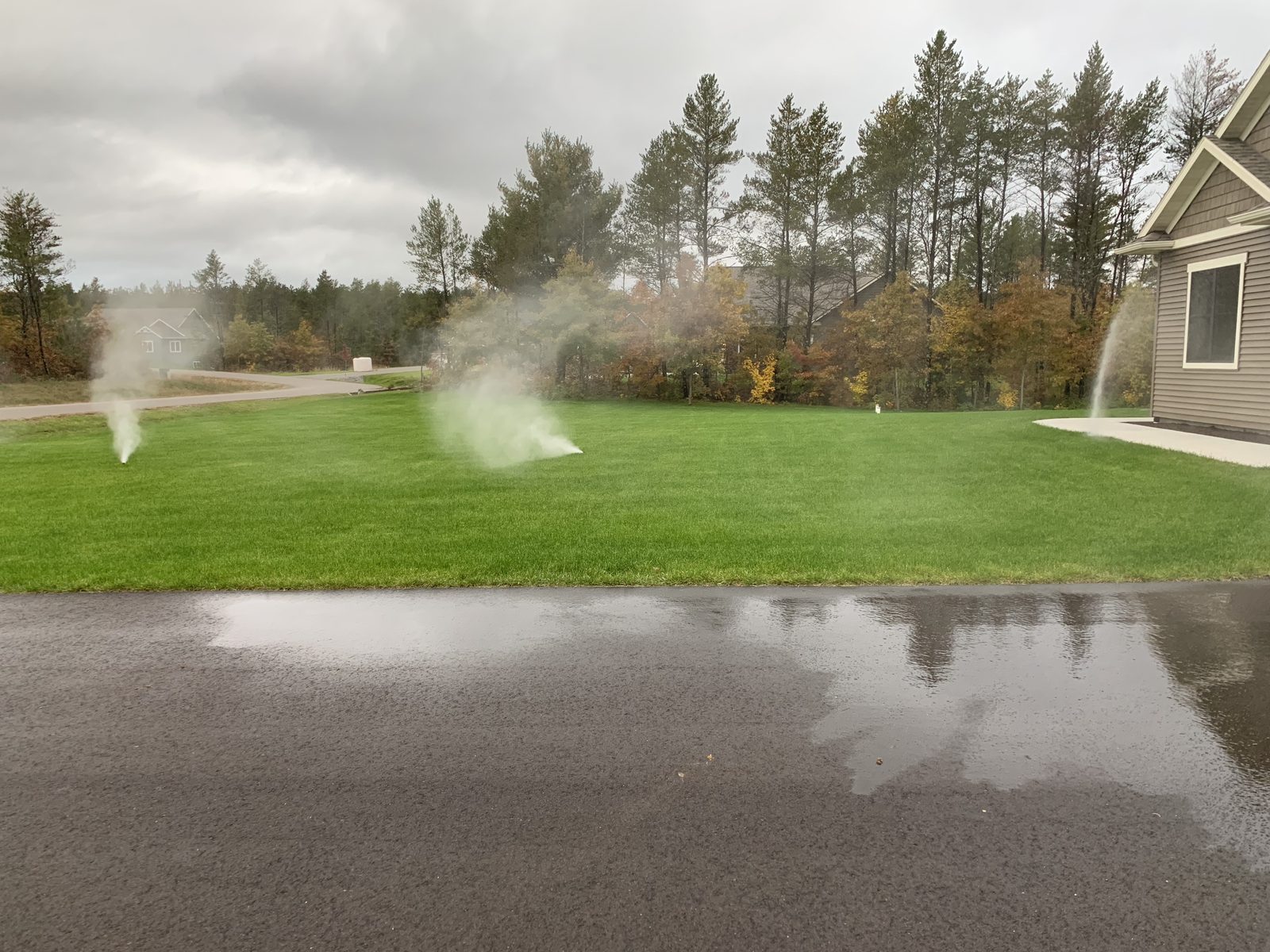
- Runoff. If water is leaving the lawn onto sidewalks, driveway, or patio during a cycle, the soil cannot absorb it as fast as you are applying it. That water is purchased and wasted.
- Persistent mud. Soil that is wet between cycles, days after rain, is holding more water than the lawn can use.
- Spongy, mushy footing. Walk across the lawn. If it feels soft and water seeps up around your shoes, the profile is saturated.
- Thickening thatch. Thatch is the layer of dead stems, crowns, and roots between the green canopy and the soil. It normally decomposes as fast as it forms. Saturated soil suppresses the microbial activity that does the decomposing, so the layer thickens, and once it passes about half an inch it starts holding water at the surface and keeping it away from the roots. For the record, grass clippings do not cause thatch; they are mostly water and break down quickly.
- Fungal disease. Pale rings, mildew on blades, mushrooms. Most lawn pathogens need extended leaf wetness and wet soil to infect.
- Insect pressure. Weakened, thin turf is more vulnerable to the insects that were already present.
Are you watering every day?
If so, that is almost certainly the problem. An established lawn should go through a wet-then-dry cycle. Letting the soil dry between waterings is what sends roots down to find moisture, and deep roots are what carry a lawn through a hot, dry stretch.
Daily watering teaches roots to stay in the top inch of soil, because that is where the water is. Then the first real heat wave arrives, that top inch dries in hours, and a shallow-rooted lawn has nothing in reserve. You get drought symptoms on a lawn that has been watered every single day.
Meanwhile you are paying for every one of those cycles.
So how much water does a lawn need?
About an inch per week, including rainfall. How long that takes to apply is the question with no universal answer, because it depends on four things:
- Soil type. Clay holds water and absorbs it slowly, so a zone might need only about 15 minutes. Water runs straight through sandy soil, which can need 45 minutes or more.
- Slope. Water sheds off a grade before it infiltrates, which means shorter cycles repeated, not one long run.
- Sun or shade. Shaded areas lose far less to evaporation and are commonly the first place overwatering shows up, because they are on the same zone as full-sun turf.
- Head type. Rotors that rotate as they water apply slowly and might need 30 minutes. Fixed spray heads apply much faster and might need 10.
Measuring beats guessing. Put several straight-sided containers around a zone, run it for a set time, and measure what collected. That tells you the actual application rate and whether coverage is even. If the numbers vary a lot between containers, the problem is the system, not the schedule.
If you would rather not work this out zone by zone, an irrigation company can assess soil, slope, exposure, and head type and build the program around them.
Your system may be overwatering without your knowledge
Controller programming
When a technician programs a controller, it is set for current conditions and the system's actual output. Then the settings drift: someone adjusts them, or they simply stay where they were. A schedule built for a hot, dry August running into a cool, wet September delivers far more water than the lawn needs, and nobody is outside at 4 a.m. to notice. In Minneapolis and Eau Claire that swing is sharp enough that one program can be about right in August and double what the turf uses by the end of September.
Change the program as the season changes. If you have a smart controller, confirm it is actually receiving weather data rather than quietly running a fallback schedule.
Rain sensor
A rain sensor only works if it works. Check the batteries, clear debris, and make sure nothing has grown over it. A failed sensor means the system runs during a rainstorm, which is both wasteful and visible to the entire neighborhood.
Worn or broken heads
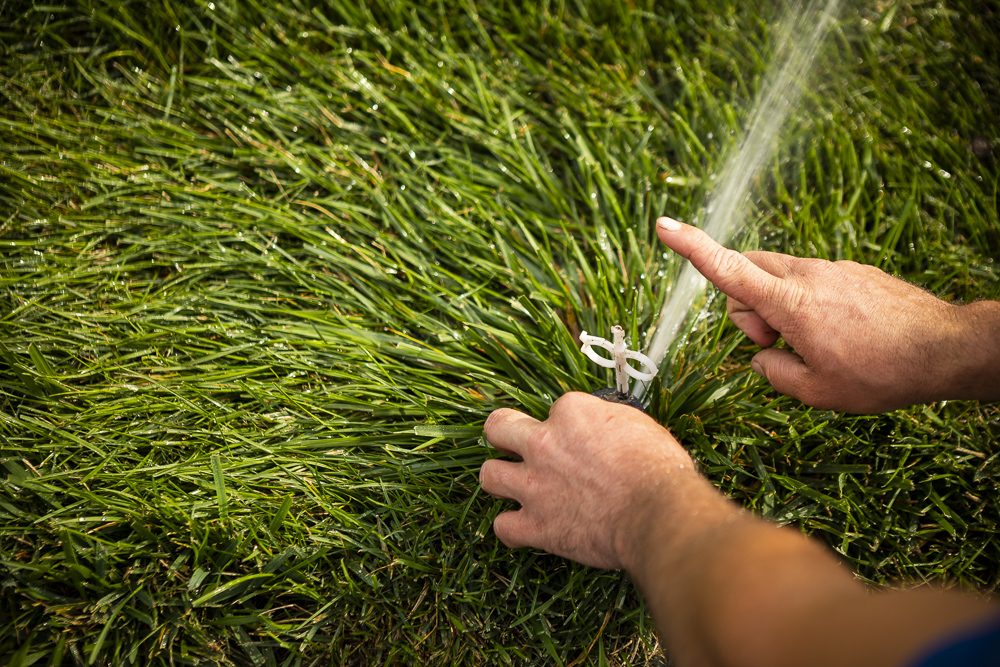
Heads take abuse. Mowers clip them, plows crush them, and nozzles wear. A worn nozzle throws a different pattern and often more water than designed. A cracked head leaks the entire time the zone runs. A head knocked off arc can soak one area twice while another gets nothing, so you end up adding run time to fix the dry spot and badly overwatering the wet one.
Leaking valves
Valves are the faucets of the system, and like any faucet they can fail to seat fully. A weeping valve lets water through continuously, not just during a cycle. The symptom is usually a chronically soggy area near a valve box or the lowest head on a zone, and the cost shows up on the water bill as a baseline that never drops.
When was the system last tuned up?
If a professional has not inspected the system recently, assume something is off. A proper tune-up runs every zone and watches it, checks and adjusts every head for arc and alignment, looks for leaks at valves and fittings, tests the rain sensor, and reprograms the controller for current conditions.
That is also the only reliable way to find the slow problems, because the expensive failures in irrigation are the quiet ones. A leak underground can wash out a retaining wall, undermine pavement, or kill established plantings before anyone sees standing water. Regular inspection finds it while it is still a repair instead of a reconstruction.
Bottom line
- Saturated soil pushes oxygen out of the root zone. Overwatered and underwatered lawns look similar, so diagnose from the soil and the system.
- Watch for runoff, spongy footing, persistent mud, pale color, thickening thatch, and fungal disease.
- Target about an inch of water per week including rain, applied in longer cycles on fewer days.
- Run time depends on soil, slope, exposure, and head type. Measure output with containers rather than guessing.
- Controller drift, a dead rain sensor, worn heads, and weeping valves all overwater without any visible sign.
Frequently asked questions
How can I tell if I am overwatering or underwatering?
Check the soil, not the grass. Push a screwdriver into the lawn: if it slides in easily and the soil is wet several inches down a day after watering, you are applying too much. Dry and hard at two inches means too little. Spongy footing and runoff both point to too much.
Is it bad to water in the evening?
Yes. Evening and overnight cycles leave the canopy wet for hours, which is the condition most lawn pathogens need. Finish watering by sunrise.
Why is one area always soggy?
Common causes are a leaking valve, a cracked head, a low spot collecting runoff, or a shaded area on the same zone as full-sun turf. Each needs a different fix, and adding or cutting run time for the whole zone addresses none of them.
Will a smart controller stop overwatering?
Only if it is installed correctly, connected to weather data, and paired with a working sensor and properly adjusted heads. A smart controller on a system with worn nozzles and bad coverage still waters unevenly.
U.S. Environmental Protection Agency WaterSense, Watering Tips.
U.S. Environmental Protection Agency WaterSense, Landscaping Tips.


