


How to Improve Lawn Drainage Without Causing Turf Damage
A lawn that holds water after every rain is usually telling you one of three different stories: compacted soil, a thatch layer the water cannot get through, or a grading problem. The fixes are not interchangeable, and the least invasive ones are worth trying first. Here is how to tell them apart.
First, figure out which problem you have
Before spending money, narrow it down. Grab a shovel and cut a wedge of turf about six inches deep in the wet area and look at the profile.
- Dense, hard soil that resists the shovel and shows few roots below two inches: compaction. Aeration is your first move.
- A spongy brown layer more than half an inch thick between the green blades and the soil: excess thatch, which sheds water like a sponge wrapper. Aeration plus topdressing addresses it.
- Soil that is saturated well below the surface, or water visibly running in from somewhere and pooling: this is a grading or water-volume problem, and no amount of aeration will fix it.
The last one is worth checking before anything else. Walk the yard during a hard rain. If water is coming off a downspout, a neighbor's slope, or a driveway and collecting in a low spot, you have a drainage route problem, not a soil problem.
Does aeration help with drainage?
For compaction, yes, and it is the first thing to try because it is inexpensive and it helps the lawn in several other ways at the same time.
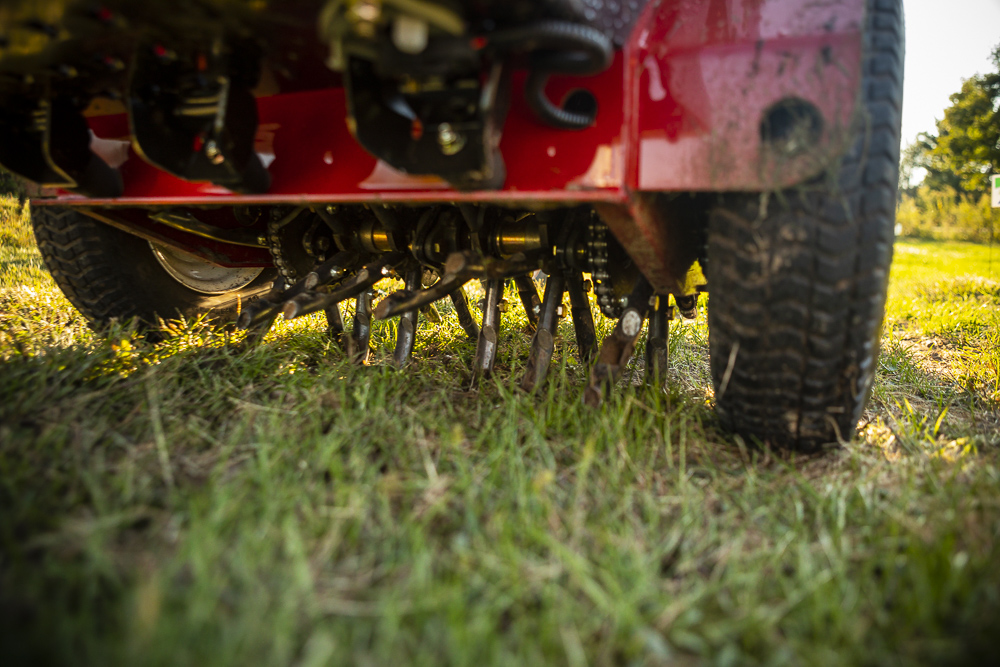
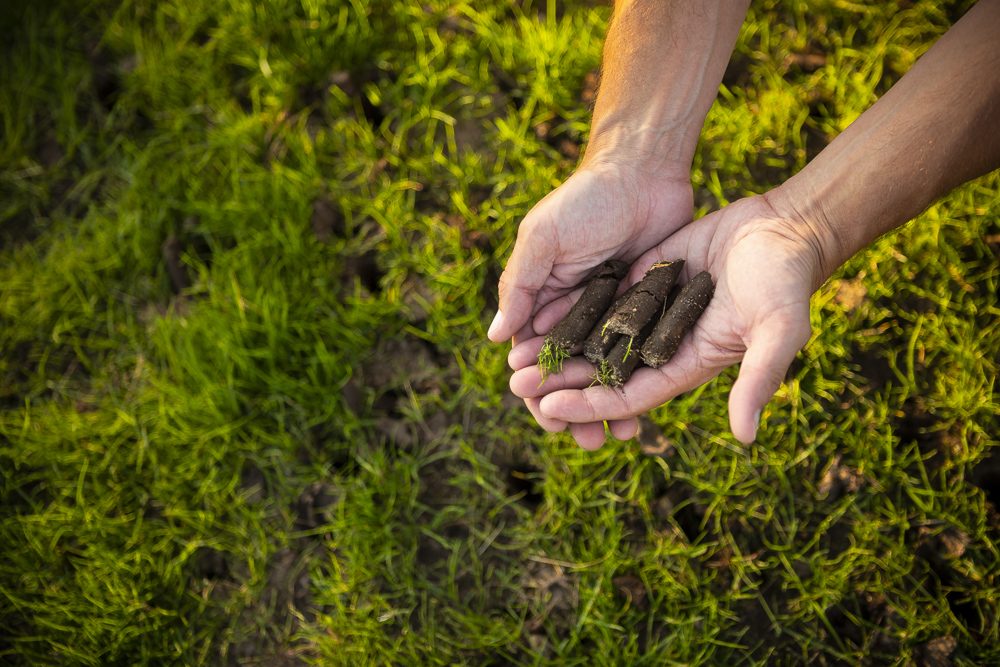
Core aeration uses a machine to pull plugs of soil out of the ground, leaving open channels. Water that was sitting on top of hard, impenetrable soil now has somewhere to go. Air gets to the root zone. Fertilizer and seed reach soil instead of resting on a mat of thatch.
The secondary benefits are the real argument for doing it annually. Compacted soil means roots cannot take up water or nutrients efficiently, so the lawn is simultaneously thirsty and underfed no matter what you apply. Relieve compaction and roots go deeper, and a deep-rooted lawn resists pests and disease better and holds up through summer heat and drought. In Wisconsin and Minnesota, where freeze and thaw cycles and clay-heavy soils are common, annual aeration does a lot of work.
Topdressing: the step most people skip
Topdressing means spreading a thin layer of material across the lawn surface to gradually improve the soil profile. A blend of sand and compost is typical: the sand improves pore structure and water movement, and the compost adds organic matter and biology. Sand is a mineral, not an organic material, so when you hear topdressing described as organic amendment, understand that it is usually a mix of both.
Aeration and topdressing work far better together than either does alone. The holes left by aeration give the topdressing somewhere to go, so the material works down into the profile instead of sitting on top. Done once a year over a few seasons, it measurably changes how a heavy soil drains. Done once, it helps a little. It is a program, not an event.
One caution: do not try to fix drainage with pure sand on a clay soil in one heavy application. Layering sand directly on clay can create a perched water table that drains worse than what you started with. Thin, repeated applications are the right approach.
When the simple fixes are not enough
Some drainage problems are not soil problems. If a yard has a low spot that collects runoff from a roof, a driveway, or a neighboring property, the water has to be given a route out. That is grading and drainage work: regrading a swale, extending downspouts, installing a French drain or a dry well, or building a rain garden to catch and infiltrate the runoff. A rain garden is a particularly good answer in this region, since it handles the spring melt and summer downpours that overwhelm a flat yard.
That kind of work is landscaping and excavation, not lawn care, and we will tell you so. What we can do is look at the lawn, tell you honestly which category your problem falls into, and handle the parts that are ours.
Why regular service catches this early
When a lawn care technician is on your property repeatedly through the season, spreading seed, applying fertilizer, treating weeds, they are reading the whole lawn, not just completing a task. Drainage problems announce themselves in ways a homeowner does not necessarily connect: moss in the low corner, algae crust on bare soil, fairy ring or other disease clustered in the same wet area, soft ground where the mower leaves ruts, or weeds that only grow where it stays wet.
Catching those signals early is the difference between adding aeration to the plan and calling an excavator in three years.
Where drainage fits in a lawn plan
Aeration is part of a custom lawn care plan, alongside nutrition, weed control, and insect control. The order matters. Aerate and improve drainage first, because fertilizer applied to compacted, waterlogged soil mostly goes to waste, and seed sown on a surface that water cannot penetrate does not establish.
Irrigation belongs in the conversation too. A controller running short cycles every day keeps the surface wet and never lets the soil profile dry between cycles, which looks exactly like a drainage problem and is actually a scheduling problem. Before you dig anything, have the irrigation schedule and coverage checked. It is the cheapest drainage fix there is.
Bottom line
- Diagnose first. Compaction, excess thatch, and a grading problem look similar and need different fixes.
- Core aeration is the right first step for compaction and improves nutrient uptake and drought tolerance at the same time.
- Topdressing with a sand and compost blend works best right after aeration, repeated annually in thin layers.
- Never dump a heavy layer of pure sand on clay soil. It can drain worse than before.
- A low spot collecting runoff is a grading and drainage job, not something aeration will solve.
Frequently asked questions
Will aeration fix a lawn that floods every time it rains?
Only if the cause is compaction or thatch. If water is running in from a roof, driveway, or neighboring slope and pooling in a low area, you need a drainage route: regrading, extended downspouts, a French drain, or a rain garden.
How often should I aerate for drainage?
Once a year is right for most lawns in this region, and twice in the first year or two on badly compacted soil. Fall is the best timing, since the lawn is actively growing then and recovers quickly.
Is sand or compost better for topdressing?
A blend of both. Sand improves pore structure and water movement, compost adds organic matter and biology. Apply it in thin layers right after aeration so the material works into the holes rather than forming a layer on the surface.
Could my sprinkler system be causing the problem?
It often is. Short daily cycles keep the top of the soil constantly wet and never allow the profile to drain, which looks like poor drainage. Switching to deep, infrequent early morning cycles, and fixing any head that overlaps the same spot twice, is the cheapest thing to try.
University of Wisconsin Extension, Lawn aeration and topdressing.
EPA WaterSense, Landscaping tips.


