


How to Choose The Best Lawn Service for Your Needs: Tips for Eau Claire Homeowners

Two lawn care quotes can be hundreds of dollars apart and describe what looks like the same service. The gap is almost always in what goes down per visit, what grade of product it is, and what is bundled versus billed separately. Here is how to put programs side by side so the comparison means something.
Build the comparison on the visit schedule, not the visit count
Start by writing out what each program says happens at each visit across the season. A program with six visits that includes two crabgrass pre-emergent applications, season-long grub protection, and fall fertilizer is a different product than a program with seven visits of fertilizer and blanket weed spray.
What to list for each program:
- Number of fertilizer applications and roughly when they fall
- Whether crabgrass pre-emergent is applied once or twice
- Whether broadleaf weed control is included in every visit or billed separately
- Whether grub control is included, optional, or an upsell
- Whether aeration and overseeding are in the program or quoted separately
- Whether a soil test is included, and whether a pH correction is covered if it is needed
- Whether service calls between visits cost extra
When those lines are filled in for every company, the programs stop looking interchangeable.
Ask what grade of product each program uses
This is where most of the price difference lives, and it is usually invisible on a quote.
Fertilizer
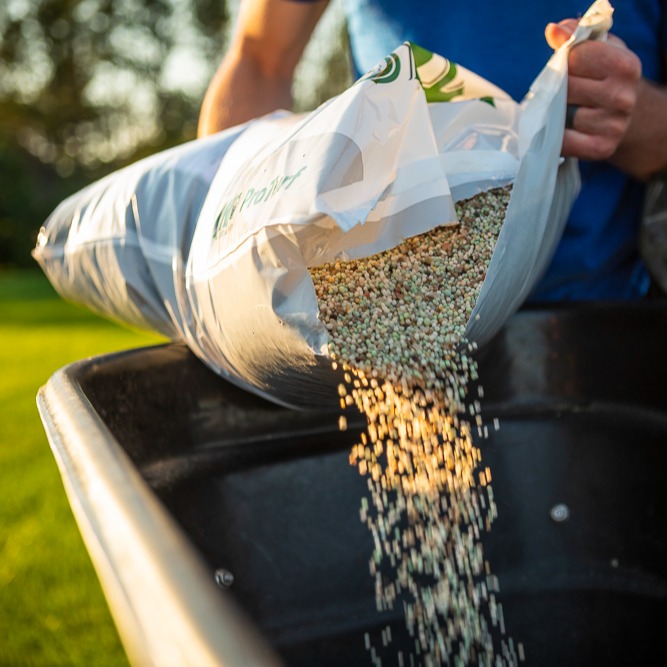
Granular fertilizer costs more than liquid and releases nutrients gradually over weeks, which produces steadier color and growth than a soluble application that flushes and fades. Steady release is also gentler on turf heading into summer heat. Ask which type the program uses and at what rate.
Weed control
Combination weed and feed granules depend on landing on and adhering to weed leaves, so coverage is uneven, and no single herbicide controls every broadleaf weed in a Wisconsin lawn. Liquid applications are made to the weeds actually present and can be mixed for them. Ask whether weed control is liquid and whether spot treatment between visits is included.
Grub control
Ask the product name and its risk profile for pollinators. Cheaper grub materials carry higher pollinator risk, and the lower-risk products cost significantly more, so a program with very cheap grub control is making that trade for you. Also ask whether the product lasts through the fall feeding window or only the first wave, because some weaken by late season.
Seed
If overseeding is included, ask what seed and at what rate per thousand square feet. Bargain seed contains more inert matter, off-type species, and sometimes weed seed, and germinates at a lower rate. Two overseeding quotes can differ by a factor of three purely on seed grade and quantity. Ask to see the tag.
Find out whether the program is diagnostic
A route program applies the same sequence to every lawn. A diagnostic program adjusts to yours. The questions that separate them:
- Do you soil test, and what do you do with the result? Cool-season turf takes up nutrients best between roughly 6.0 and 7.0 pH, and outside that range fertilizer underperforms no matter how much goes down.
- Is crabgrass pre-emergent timed to soil temperature, or to a route date? Germination starts when surface soil holds in the mid-50s Fahrenheit, which in Wisconsin can be March or May depending on the year.
- Who decides whether my lawn needs aeration this year, and on what basis?
- What happens if a disease shows up mid-season?
Add up the real annual cost
Compare total annual spend, not per-visit price. Build the number the same way for each company:
Base program cost, plus aeration if it is not included, plus overseeding, plus grub control if it is optional, plus any mid-season service call fees, plus soil testing or pH correction if those are billed. A program that looks cheaper per visit frequently ends up higher once aeration, grubs, and seed are added back.
Also ask whether pricing is published. A company that posts program pricing has already committed to a number before you call, which makes comparison straightforward. RainMaster publishes pricing for all services on the site for exactly that reason.
Weigh the operational details
These are not technical, but they determine whether the service is pleasant to live with:
- Advance notice. You need to move toys, bring the dog in, and unlock the gate. RainMaster sends email and text notifications before service.
- Post-service communication. Our technicians call after finishing to say what was done and flag what they saw. Knowing a disease is starting is worth more than the application itself.
- Coordination with irrigation. On our highest-level aeration service we flag sprinkler heads before aerating so they do not get hit, and reset the irrigation controller for the watering schedule new seed needs. If lawn care and irrigation are handled by different companies, that coordination is on you.
- Who you reach. Whether you can talk to the specialist who services your lawn rather than a dispatcher.
RainMaster's three program levels
We offer three tiers so the program can match the lawn and the budget rather than forcing one answer:
Luscious Lawn is the high-end proactive program, built for the fastest and strongest results, and the right choice for a lawn that needs significant help. Terrific Turf is the mid-level option and our most popular, aimed at a thick green lawn that handles most common problems. Healthy Habitat is the basic plan covering the core elements a better lawn requires.
Each program is detailed on the site with what it includes and what it costs, so you can line it up against any other quote without a sales call. We have worked on Eau Claire lawns since 1999. See lawn care or request a quote.
Bottom line
- Compare what happens at each visit across the season, not how many visits there are.
- Ask the grade of every product: fertilizer type, liquid versus granular weed control, grub product and its pollinator risk, and seed grade and rate.
- Find out whether the program is diagnostic: soil testing, pre-emergent timed to soil temperature, and a basis for recommending aeration.
- Total the real annual cost including aeration, overseeding, grub control, and service call fees before comparing.
- RainMaster publishes program pricing and offers three tiers: Luscious Lawn, Terrific Turf, and Healthy Habitat.
Frequently asked questions
How do I compare two lawn care quotes fairly?
Write out what each program does at every visit, then add aeration, overseeding, grub control, and any service call fees to each base price so you are comparing total annual cost for equivalent work.
Does a program with more visits produce a better lawn?
Not on its own. What goes down each visit, the grade of the product, and whether anyone diagnoses the lawn matter far more than the number of times a truck arrives.
Should crabgrass pre-emergent be applied once or twice?
Crabgrass germinates in waves from early spring into summer, so a single application can lose strength before the later flushes. RainMaster applies it twice, early and late spring, and times it to soil temperature rather than a route date.
What should I ask about grub control in a program?
The product name, its risk to bees and other pollinators, and whether it stays active through the fall feeding window. Cheaper grub materials carry higher pollinator risk and some weaken before the second wave of feeding.
University of Wisconsin Extension, Lawn Fertilization.
University of Wisconsin Extension, Crabgrass Management in Lawns.


