


How to Care For New Grass: 9 Tips to Maintaining Your New Lawn

New grass is the most fragile your lawn will ever be. The seedlings have shallow roots, no reserves, and no ability to outcompete anything, so the first two months of care decide whether you get a thick stand or a thin one you fight for years. Here is what matters, in the order it matters.
1. Start with starter fertilizer, and find out what the soil actually needs
Starter fertilizer is formulated for seedlings. It carries phosphorus, which supports root development, and a quicker-release form of nitrogen in smaller doses, because tender new roots cannot reach far for nutrients and cannot wait on a slow-release product. Once the stand matures, it does better on the slow-release nutrition in a regular fertilizer.

This is also the right moment for a soil test. Cool-season turf takes up nutrients best when soil pH sits roughly between 6.0 and 7.0. Outside that range, the nutrients can be present in the soil and still be largely unavailable to the plant, so you fertilize and see very little for it.
One correction worth making: lime raises soil pH, and elemental sulfur lowers it. Gypsum does neither. Gypsum is calcium sulfate, so it supplies calcium and sulfur, and it is sometimes used on sodic soils, but it will not move pH in either direction. If a soil test says your lawn is acidic, you need lime, not gypsum.
2. Keep fertilizing through the season
Fertilizer is not a one-time event at seeding. A new lawn needs feeding across the growing season, and then into fall, which is the most valuable application of the year for cool-season grass in this region. What it does not need is a heavy hand. Pushing a young lawn with extra nitrogen produces soft, fast top growth at the expense of roots, and soft growth is what disease and heat stress take first.
3. Water new grass more often, in smaller amounts
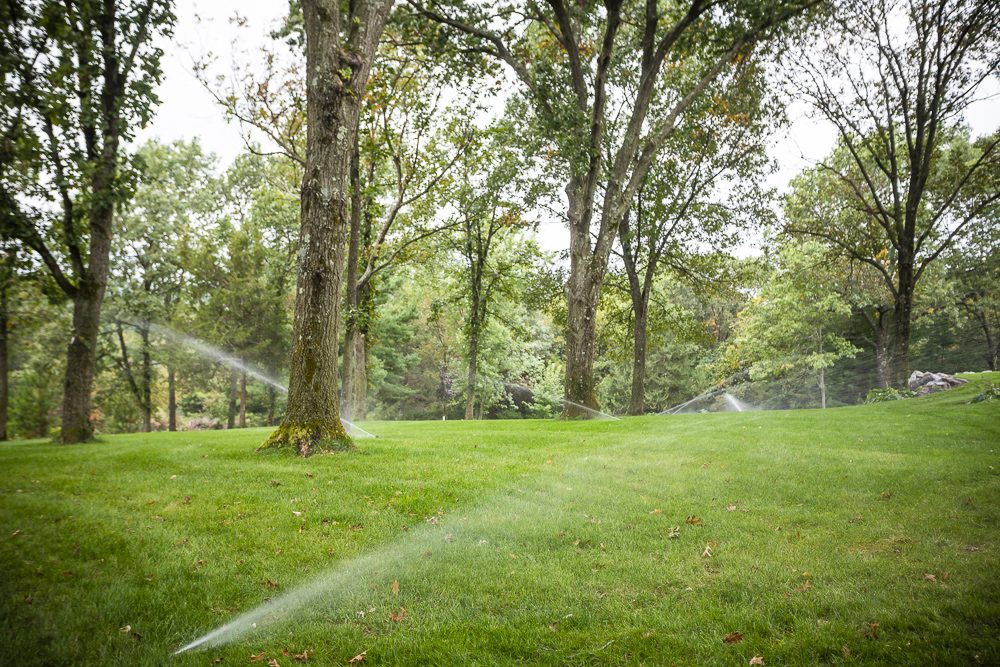
New seed needs the top half inch of soil to stay consistently moist, which usually means light watering two or three times a day for 15 to 20 minutes per cycle. This is the opposite of how you water an established lawn.
After four to six weeks, start the transition: longer cycles, fewer of them. The point is to make the roots chase moisture downward instead of living in the top inch of soil. Deeper roots are what carry a lawn through a dry August.
Do not overdo it. Overwatering a new lawn is at least as common as underwatering it. Saturated soil pushes out air, and roots need air as much as they need water. If the surface is squishy underfoot or water is standing, back off.
4. Do not use weed killer on new grass
Wait at least a month, and use mowings as your counter: if you mow weekly, mow at least four times before applying a standard broadleaf weed control. New lawns almost always come in weedy, and the weeds grow faster than the grass, which makes the temptation real. Most consumer weed control products will injure or kill seedlings along with the weeds.
There is one exception. Professional-grade products exist that can be applied to new seedings safely, which is why a lawn care program can treat weeds on the same day it seeds.
5. Aerate and overseed in the first year or two
Aeration is not only for compacted lawns. Core aeration loosens soil, opens channels for air and water, and leaves hundreds of small holes that give overseeded grass ideal seed-to-soil contact. That is why pairing overseeding with aeration thickens a young lawn faster than seeding alone.
New sod benefits particularly. A sodded lawn sits as a dense mat over the existing soil with less air movement at the soil surface, which makes it more disease-prone early on than a seeded lawn. Expect a new lawn to have thin areas for the first couple of seasons, and plan an annual aeration and overseeding pass to fill them.
6. Mowing a new lawn
- Make sure it is rooted first. With new sod, give it a tug. If it lifts, the roots have not knit into the soil and the mower will move it. With seed, wait until the stand reaches mowing height across the area, not just in patches.
- Mow high. Target about 3 inches in June and 3.5 to 4 inches in July and August. Taller grass shades the soil, roots deeper, and crowds out weeds.
- Never remove more than a third of the blade in a single cut, and keep the blade sharp. A dull blade tears seedling tips instead of cutting them.
- Stay off wet ground. Mowing saturated soil leaves ruts and footprints in a surface that has no root structure to recover with, and wet clippings clump and sit on the canopy.
- Go easy on turns. Spinning a drive wheel on a six-week-old lawn takes the stand down to bare soil in one pass.
7. Grub control on a new lawn
Grub control is appropriate in the first year and will not harm new turf. It is worth being precise about how it works, because the common explanation is wrong: a preventive grub product does not kill eggs. It is applied and watered in ahead of the hatch so the material is already present in the soil and root zone, and it kills the young larvae shortly after they hatch and begin feeding, before they are large enough to shear roots and cause visible damage.
Timing follows the beetle flight, so preventive applications go down in spring and early summer here. If you are establishing a lawn in fall, you can skip it. The grub feeding window for that season has closed.
8. Keep up the care past the first year
Most lawns that disappoint people were established well and then left alone. The gains from a good establishment year hold only if the lawn keeps getting fed on schedule, aerated annually, overseeded where it thins, and watered properly. That is what a season-long program is for: fertilizer at the right intervals, weed control, aeration and overseeding, grub protection, and a watering plan that matches the weather rather than the calendar.
9. Programs for a new lawn in Eau Claire and the Twin Cities
RainMaster offers three levels of lawn care, and the right one depends on how much help the lawn needs and how fast you want results. Luscious Lawn is the high-end proactive program, built for the quickest and best results and for lawns starting from a rough baseline. Terrific Turf is the mid-level option and the most popular, aimed at a thick green lawn that handles most common problems. Healthy Habitat is the basic plan with the core elements a better lawn requires. All three can be paired with irrigation service so watering is not left to guesswork during establishment.
Bottom line
- Use starter fertilizer at seeding, and soil test before amending. Lime raises pH and sulfur lowers it; gypsum changes neither.
- Water lightly two or three times a day for the first four to six weeks, then shift to longer, less frequent cycles.
- Wait at least four mowings before applying consumer weed control, or use a professional product labeled for new seedings.
- Mow at 3 inches in June and 3.5 to 4 inches in midsummer, never cutting more than a third of the blade.
- Preventive grub control kills young larvae just after hatch, not eggs, so it has to be down before the hatch. Skip it on a fall seeding.
Frequently asked questions
How long before I can mow a new lawn?
With seed, wait until the stand has reached mowing height uniformly across the area, usually three to four weeks depending on temperature and moisture. With sod, tug on a corner first; if it lifts off the soil, the roots have not knit in yet and a mower will shift it.
How often should I water new grass seed?
Light watering two or three times a day, roughly 15 to 20 minutes per cycle, keeping the top half inch of soil consistently moist. After four to six weeks, move to longer and less frequent cycles so roots grow downward.
Can I apply weed killer to a new lawn?
Not a standard consumer product. Wait at least a month, or four mowings. Professional products labeled for use on new seedings exist and can be applied the same day the lawn is seeded.
Does a new lawn need aeration?
Yes, within the first year or two. Aeration is not only for compaction. It improves air and water movement and gives overseeded grass the soil contact it needs, which is how a thin young lawn thickens up fastest.
University of Wisconsin Extension, Lawn Establishment and Renovation.
University of Minnesota Extension, Seeding and Sodding Home Lawns.


