


Do I Still Need to Spray My Yard for Mosquitoes & Ticks in Fall?

Mosquito season in Wisconsin and Minnesota typically runs until the first hard frost in October, and ticks do not die off in fall at all, they just slow down when it gets cold. That is why the last treatments of the year still matter, and why the season does not end when the calendar flips to September.
How long mosquito and tick season actually lasts here
Mosquitoes stay a nuisance well into October in this region. A hard freeze is what ends the season, and the timing of that varies year to year. Control programs generally wrap up by the end of September, with the final three-week treatment carrying protection into October, which covers the stretch when you are outside for yard cleanup and backyard football.

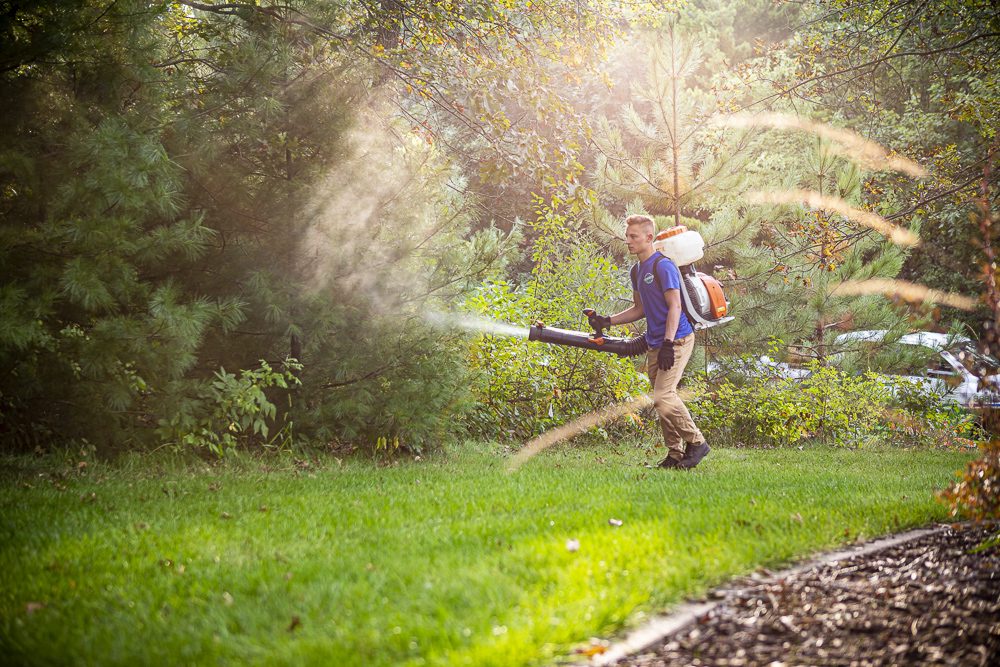
Ticks are a different story. They do not die in fall or winter. They become less active when temperatures drop, but adult blacklegged ticks are active in fall and will quest on any day that stays above freezing. Fall yard work puts you in exactly the habitat they use, which is why the last treatments of the year are as useful as the first.
In the spring, treatments here start in mid-May, depending on the weather.
How professional mosquito spraying works
The treatment is a barrier application to the perimeter of the yard and to the harborage where mosquitoes actually rest during the day. Mosquitoes do not hover in open sun; they sit in cool, shaded, humid places and come out to feed. Targeting those areas is what makes the difference:
- The undersides of plant leaves and dense shrub interiors
- Shaded areas along the house and fence lines
- Damp low spots and standing water margins
- Under decks and porches
- Under tree canopies and along wood lines
- Wood piles and stacked materials
It works right away. RainMaster's barrier spray reduces mosquitoes on the property with regular visits every three weeks, and the same application reduces ticks, which are also active in October.
One thing to be straight about: be skeptical of any company in Eau Claire or Minneapolis that promises to eliminate every mosquito in your yard. We call it mosquito reduction for a reason. You will see a large reduction in mosquitoes and ticks, not a sterile yard.
How often spraying is needed
One visit controls mosquitoes and ticks for about three weeks, which works out to six visits across the season for a yard in Eau Claire or the Twin Cities. The reason is the same as with the repellent you spray on yourself: the residual only lasts so long. On top of that, mosquitoes reproduce continuously, so there is always a new population moving in from surrounding property.
Six visits from spring through fall covers the whole outdoor season, from the first warm days through the point where you are pulling out flannel and baking apple crisp.
Is it safe for family and pets
Stay inside while the technician is treating, and stay off the treated areas while they are still wet. Once the application has dried, which takes roughly 30 minutes, you and your pets can go back out. That is the whole protocol, and following it is what keeps it straightforward.
What ticks actually do, since the myths cause bad decisions
Ticks do not jump, fly, or drop out of trees. They cannot. A tick waits on low vegetation, usually within a foot or two of the ground, with its front legs extended, and grabs on when a host brushes past. That behavior is called questing.
This matters because it tells you where the risk is and where treatment belongs: tall grass, leaf litter, the brushy transition between a mowed lawn and a wood line, and groundcover along shaded edges. It is not the tree canopy. Keeping the lawn mowed, clearing leaf litter, and cutting back the brushy edge of the property removes tick habitat more reliably than any spray.
Other things that reduce mosquitoes in your yard
- Eliminate standing water. Mosquitoes breed in it, and it takes very little. Old tires, clogged gutters, buckets, wheelbarrows, empty flower pots, tarps, and birdbaths all qualify. Dump anything holding water weekly.
- Remove leaf litter. Damp, dark leaf layers are resting habitat for mosquitoes and prime tick habitat at the same time.
- Cut back tall grass and brush around the house and along the lawn's edge, and keep the lawn mowed.
- Stack wood neatly, off the ground, in a dry spot. Loose damp wood piles shelter both pests and the rodents that carry ticks.
- Keep playsets, decks, and patios away from yard edges and tree lines rather than tucked against them.
- Invite birds and bats with houses on the property. They eat mosquitoes.
- Run fans on the patio. Mosquitoes are weak fliers, and a fan both pushes them off course and disperses the carbon dioxide they use to find you.
Do we tell you when we are coming
Yes, and you should expect that from any company. You get automatic scheduling, so you do not have to call to set up each visit, plus an email or text reminder the day before. Nobody should come home to find a service flag in the yard and realize the dogs were out running around during a treatment.
Start mosquito and tick reduction in spring and the program carries protection through fall.
Bottom line
- Mosquito season in WI and MN runs until the first hard frost, usually in October, so the final treatments still count.
- Ticks do not die off in fall. Adult blacklegged ticks quest on any day above freezing.
- Ticks cannot jump, fly, or drop from trees. They wait on low vegetation, so tall grass, leaf litter, and brushy edges are the risk.
- One barrier treatment lasts about three weeks, which is six visits across the season.
- Stay off treated areas until dry, about 30 minutes, then normal use resumes for people and pets.
Frequently asked questions
Is it worth spraying for mosquitoes in the fall?
Yes, if you are still using the yard. Mosquitoes stay active until a hard frost, and the same application reduces ticks, which are actively questing through fall yard cleanup season.
How long until I can let my kids and dog back outside?
Once the treated areas are dry, which is about 30 minutes. Stay inside during the application and until it dries, then normal use is fine.
Can ticks fall on me from a tree?
No. Ticks cannot jump, fly, or drop from above. They climb low vegetation and wait for a host to brush past, which is why tall grass and the brushy edge of a yard are the places to be careful.
How many treatments do I need in a season?
Six, spaced about three weeks apart from mid-May through the end of September, with the last application carrying into October.
University of Minnesota Extension, Ticks and tickborne diseases.
University of Wisconsin Extension, Yard and garden pest guidance.


