


Did You Over-Fertilize Your Lawn? How To Know and What to Do
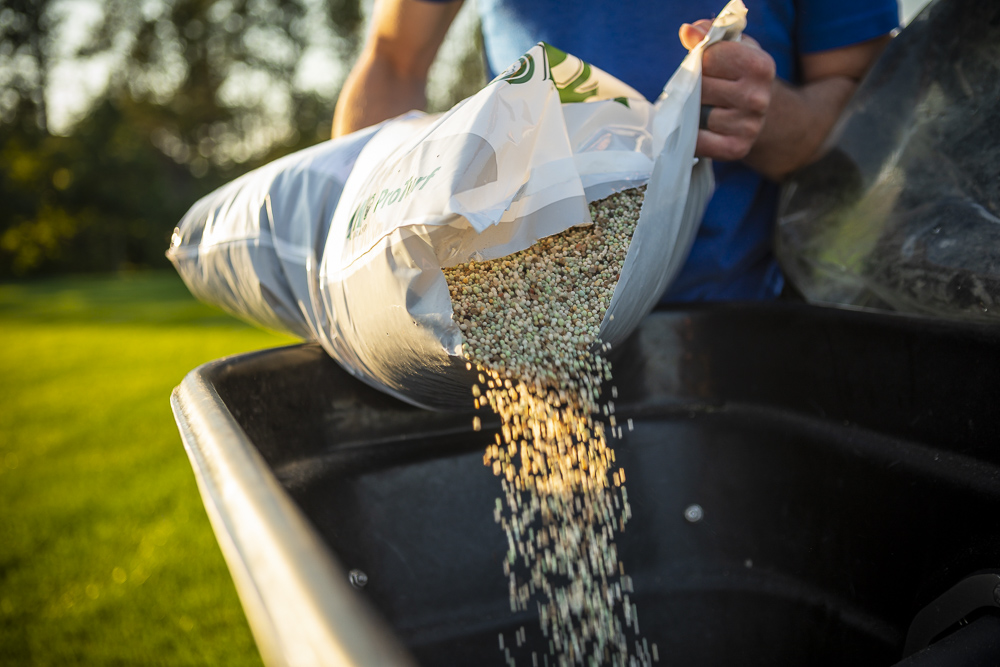
Too much fertilizer does not make a lawn greener, it burns it. Excess nitrogen and the salts that carry it pull moisture out of grass roots and leaf tissue, and the damage usually shows up days to a couple of weeks later as yellow or brown streaks that follow the path of your spreader. If you catch it early, deep watering to flush the excess out of the root zone is the fix, and whatever does not recover gets reseeded.
What happens when you over-fertilize a lawn
The three nutrients that make turf thick and green, nitrogen, phosphorus, and potassium, are also what damage it when you apply too much at once. The problem is not really the nutrients, it is the salt. Fertilizer is a salt, and a heavy application raises the salt concentration in the soil above what the roots can tolerate. Water then moves out of the plant instead of into it, and the grass dehydrates in place. That is fertilizer burn, and it looks almost identical to the yellow and brown dog urine spots you see in lawns, for the same chemical reason.
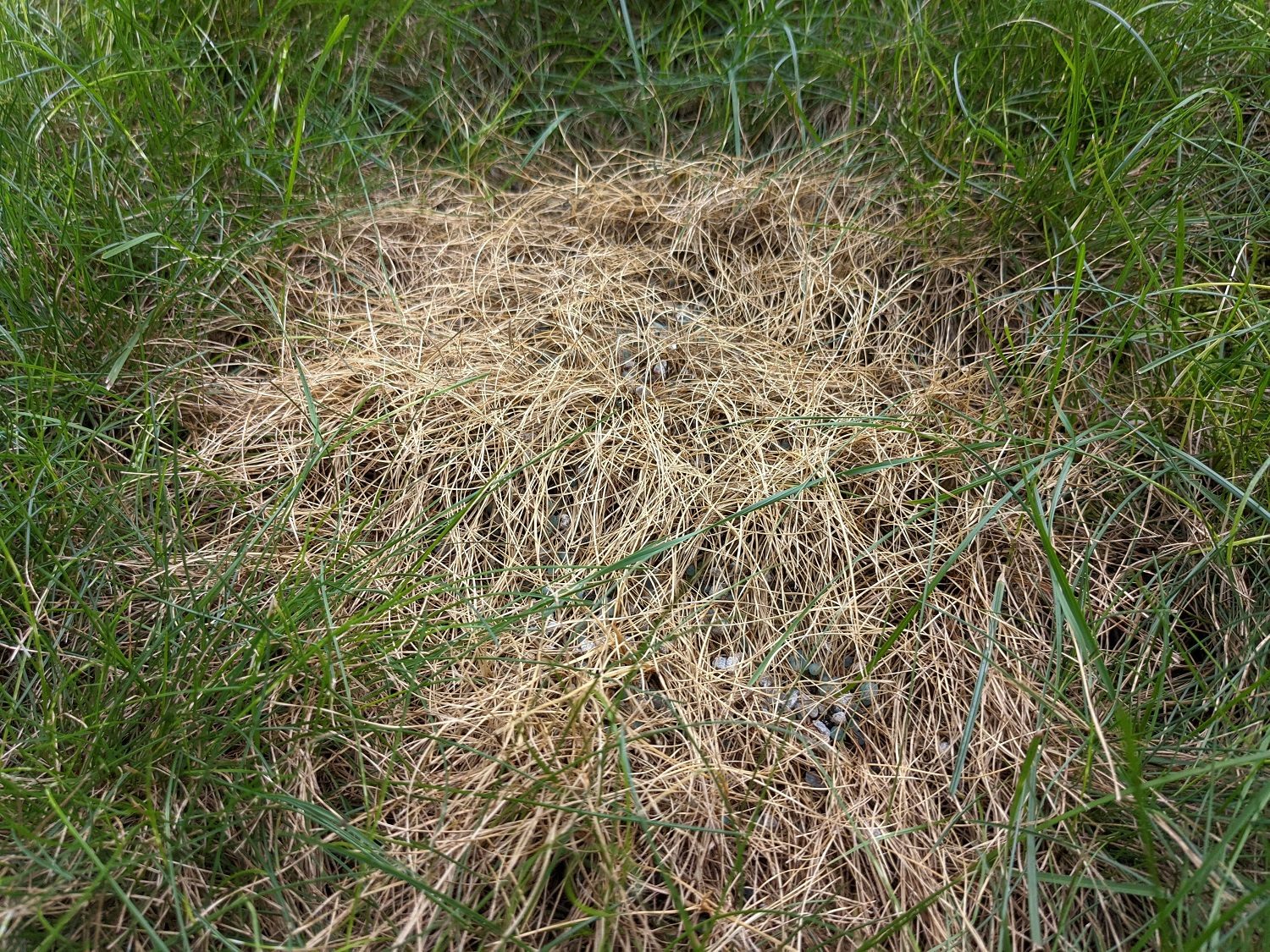

How fast it shows up depends on how soluble the product is. Liquid applications and quick-release granular products such as urea put soluble nitrogen into the soil immediately, so they carry the higher burn risk. Slow-release and organic-based granular fertilizers release nitrogen over weeks, which is far more forgiving of a heavy pass. The distinction is release rate, not liquid versus granular, so a quick-release granular product applied twice over the same strip will burn a lawn just as thoroughly as a liquid one.
Heat and drought make everything worse. Fertilizer applied to turf that is already stressed in a dry July week, with no irrigation to move it into the soil, is the most common way homeowners here kill grass with a product meant to feed it.
Signs you over-fertilized your lawn
Stripes, overlaps, and turn marks
The pattern tells you the cause. Fertilizer burn follows equipment: darker green or dead stripes where passes overlapped, heavy patches where the spreader sat still or where you turned at the end of a run, and a clean line where the application stopped. Disease and insect damage do not make straight lines.
Yellow or brown leaf tips first
Before whole patches die, you often see the tips of the blades go yellow or tan while the base stays green. That is the early warning, and it is the point at which watering still saves the grass.
Growth that stalls instead of surges
A correctly fed lawn pushes new growth within a week or two. An over-fed one can sit flat, or surge hard for a few days and then collapse. In severe cases you will see a white crust of salt residue on the soil surface in the worst spots.
Damage that shows up late
Nothing looks wrong for the first several days. Then yellowing appears, and over the following week or two it turns brown and thins out. By the time most people connect the damage to the application, it has been two weeks.
Why this happens on do-it-yourself applications
This is one of the most common homeowner lawn mistakes, and it is rarely carelessness. A professional applicator is running calibrated equipment and knows the measured square footage of the lawn. The spreader in your garage has probably never been calibrated, and the setting numbers on the dial do not translate between brands or products. Add in a lawn whose square footage is a guess, bag instructions written for a different nutrient analysis, and the temptation to use up what is left in the hopper, and the math goes wrong quickly.
What to do if you over-fertilized
Water deeply, for several days
Water is what moves the excess salt and nitrogen down past the root zone. Start as soon as you realize what happened, and water the affected area deeply rather than in short bursts, for several days in a row. Soak it, let it drain, repeat. Avoid running so much water that it sheets off the lawn onto the driveway or into the street, because that carries fertilizer straight to a storm drain. Minnesota restricts phosphorus in lawn fertilizer for exactly that reason, and both states sit in watersheds that pay for the runoff.
Sweep up what landed on hard surfaces
Granules on a driveway, sidewalk, or patio do nothing for the lawn and wash directly into the storm system. Sweep or blow them back onto the turf before you water.
Stop applying anything else
No second fertilizer application, no weed control, no fungicide. Herbicide on salt-stressed turf compounds the injury. Give it four to six weeks before you put another product down.
Raise the mower and keep traffic off
Mow high, around three to three and a half inches, and keep foot traffic, pets, and equipment off the damaged area while it recovers. Longer blades shade the soil and support the root system that is trying to rebuild.
Reseed what does not come back
Grass that is only burned at the tips recovers. Spots that are fully dead will not, because the crown is gone. Rake out the dead material to expose soil, seed, and keep the surface consistently moist until germination. In the Chippewa Valley and the Twin Cities, mid-August through mid-September is the best seeding window for cool-season grass, with soil still warm and weed pressure dropping. Spring seeding works, but it competes with crabgrass and leaves young seedlings to face their first summer with shallow roots. Our lawn care programs include the follow-up work on repaired areas.
How to avoid it next time
- Measure the lawn. Actual square footage, not an estimate. Every rate on a bag depends on it.
- Soil test before you add anything. A test tells you what the soil is short on and what it already has plenty of, including pH, which controls whether the turf can use the nutrients at all.
- Use slow-release. Organic-based granular fertilizer is the base of all three of our programs because it feeds steadily and tolerates application error.
- Split the rate. Apply half the rate in two perpendicular passes rather than one heavy pass. Overlap errors cost you much less that way.
- Water it in. Unless the label says otherwise, irrigate after a granular application so the product moves off the leaf and into the soil.
- Skip the midsummer feeding on stressed turf. Dormant or drought-stressed grass cannot use it and burns easily.
If you would rather not spend a Saturday in the fertilizer aisle doing the math, request a quote or call 888-839-8484 and we will walk the property with you.
Bottom line
- Fertilizer burn is salt injury: too much soluble nitrogen pulls water out of the grass, and the damage follows the spreader pattern in straight lines and overlaps.
- Quick-release liquids and urea-based granular products burn fastest; slow-release and organic-based granular fertilizers are far more forgiving.
- Water the area deeply for several days to flush the excess, but not so hard that it runs off into the street or a storm drain.
- Hold off on all other products for four to six weeks, mow high, and keep traffic off the area.
- Reseed what is fully dead, ideally mid-August through mid-September in Wisconsin and Minnesota.
Frequently asked questions
How long does it take for an over-fertilized lawn to recover?
Grass with only tip burn usually greens back up in two to three weeks with deep watering. Fully dead patches do not recover at all and have to be reseeded, which takes a full growing season to blend in.
Can you fix fertilizer burn by watering?
Watering is the only immediate fix, and it works if you start early. Deep, repeated watering moves the salt and excess nitrogen below the root zone. It will not revive grass whose crown has already died.
How can I tell fertilizer burn from lawn disease?
Look at the shape. Fertilizer burn follows equipment paths: stripes, overlaps, turn marks, and a sharp edge where the application stopped. Disease shows up as irregular patches, rings, or spots, and it often spreads over time.
Is liquid fertilizer more likely to burn a lawn than granular?
What matters is release rate rather than form. Liquids act immediately, so they carry a higher risk, but a quick-release granular product such as urea will burn just as readily. Slow-release granular fertilizer is the most forgiving of an application error.
University of Minnesota Extension, Fertilizing lawns.
Wisconsin Horticulture, Division of Extension, Lawn Fertilization.


