Commercial Lawn Maintenance: What Property Managers Should Expect
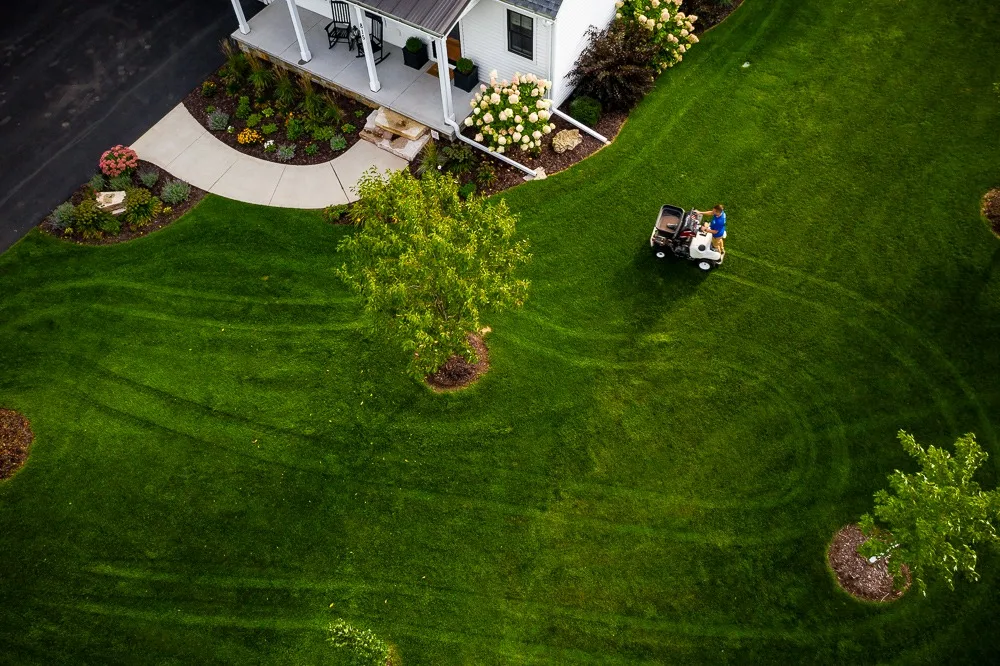
A commercial lawn maintenance contract should spell out the services included, the frequency of each, response times, and how extra work gets approved. For property managers in Wisconsin and Minnesota, it also has to account for a growing season that runs roughly seven months and a winter that needs its own plan.
Why commercial curb appeal matters
First impressions carry weight in commercial real estate. Well-maintained grounds signal that the property is run professionally, which helps attract and keep tenants and customers and supports property values. Neglected turf and overgrown beds suggest the opposite, and prospective tenants read that as a sign of how the rest of the building is managed.
Core commercial lawn services
Comprehensive commercial lawn care covers mowing with commercial equipment, a fertilization program timed to the grass type, weed control that keeps borders and beds clean, and pest management for grubs and surface insects. A typical scope includes:
- Weekly or bi-weekly mowing through the growing season, with trimming and hard-surface blow-off each visit
- Four to six balanced fertilizer applications annually
- Pre-emergent and post-emergent weed control
- Seasonal aeration and overseeding for turf density
- Spring and fall cleanup services
- Bed maintenance, edging, and mulch refresh
How the season actually breaks down here
Scopes written for a twelve-month southern season do not match this market. In practice:
- April: spring cleanup, debris removal, repair of salt and plow damage along drives and walks, irrigation startup.
- Late April through May: mowing begins and runs hardest during the spring growth flush, often requiring weekly service to avoid removing more than a third of the blade.
- June through August: mowing settles into a steadier cadence, growth slows in heat, and irrigation performance becomes the deciding factor in how the property looks.
- Late August through September: the best window for core aeration and overseeding on cool-season turf, and the period when thin areas can actually be repaired.
- October into November: leaf cleanup, the final mowings, and irrigation winterization.
- November through March: snow and ice management.
Property managers who tender lawn and snow removal together get a cleaner handoff in those October and April transition weeks, when both scopes overlap.
Irrigation management
Commercial irrigation systems need regular maintenance: spring startup, midseason inspections and adjustments, repairs as they come up, and proper winterization. On a large property the midseason inspection is the one that earns its money, because a single stuck valve or misaligned rotor on an acre of turf is both a visible brown area and a line on the water bill.
Smart controllers reduce water costs while maintaining turf health, since they skip cycles after rain and adjust run times to current weather rather than a fixed calendar. On multi-building sites, central control also means a technician does not have to walk to six controllers to make one change. See irrigation services for what commercial maintenance covers.
Contract structures and billing
Commercial contracts typically follow monthly, seasonal, or per-service billing. Monthly contracts spread cost evenly and make budgeting predictable, which is why most property managers prefer them. Per-service billing offers flexibility and tracks actual work, but it makes cash flow lumpy and invites disputes about whether a visit was needed.
Whichever structure you choose, the contract should clearly define the services included, the frequency of each, response times for repairs and call-outs, and the procedure for approving additional work. Ambiguity on those four points accounts for most of the friction between properties and grounds vendors.
Evaluating commercial lawn care providers
Look for providers with genuine commercial experience, adequate insurance coverage, backup equipment and staff so a breakdown does not become a missed week, clear communication processes, and references from properties similar to yours. The cheapest bid rarely delivers the consistency commercial properties need, and a bid noticeably below the others usually means something has been left out of the scope.
Questions worth asking
- Who is my point of contact, and what is the response time for a call-out
- What happens to my mowing day if a machine goes down or it rains three days straight
- Are irrigation, turf programs, and snow handled by your own crews or subcontracted
- What documentation do I receive after each visit or storm event
- Can you provide a certificate of insurance naming the property
We have maintained grounds since 1999 and serve commercial properties including golf courses, shopping centers, and university campuses, because those properties need reliability and consistency rather than the lowest price. See our lawn care services and service areas, or call 888-839-8484 to walk the property and scope a contract.
Bottom line
- A commercial scope should name services, frequency, response times, and the approval process for extra work.
- Plan the season for this climate: cleanup and startup in April, heaviest mowing in May, aeration and overseeding from late August into September, winterization in October.
- Midseason irrigation inspections and smart controllers are where large properties recover the most cost.
- Monthly billing gives budget predictability; per-service billing gives flexibility and less certainty.
- Evaluate insurance, backup equipment, documentation, and references before price, since the low bid usually reflects a smaller scope.
Frequently asked questions
How often should a commercial property be mowed?
Weekly through the spring growth flush and weekly to bi-weekly through summer, depending on rainfall and irrigation. The standard to hold is removing no more than a third of the blade height in a single cut.
What should be included in a commercial lawn maintenance contract?
Mowing and trimming frequency, the fertilization schedule, weed and pest control, aeration and overseeding, spring and fall cleanup, bed maintenance, response times, and how additional work is approved and billed.
Should lawn care and snow removal be with the same contractor?
It usually helps. One vendor means one point of accountability for the April repairs to turf and edges that winter plowing caused, instead of two companies pointing at each other.
Why are commercial lawn care bids so different from each other?
Almost always scope. Visit counts, fertilizer application counts, whether cleanups and aeration are included, and insurance levels vary widely. Compare the line items, not the total.
EPA WaterSense, Landscaping Tips.
University of Wisconsin Extension, Lawn Aeration and Topdressing.